 comparison
London Interiors Shutters vs Plantation Shutters (2026)
Table of Contents
- London Interiors Shutters vs Plantation Shutters: What's the Difference?
- Quick Comparison: Interior Shutters vs Plantation Shutters
- Plantation Shutters for Bay Windows: Why Fit Matters More Than Style
- Shutter Material Comparison: MDF vs Hardwood
- Bespoke Shutter Installation Costs: What Actually Drives the Price
- Made-to-Measure vs Off-the-Shelf: Where London Interiors Shutters Win
- Which Shutter Type Suits Your Home? A Decision Framework
- Conclusion
- Frequently Asked Questions
Last Updated: September 11, 2026
London Interiors Shutters vs Plantation Shutters: What's the Difference?
The terms are used interchangeably across the trade, but they describe two different things. Interior shutters is the broad category for any made-to-measure internal window covering built from hinged or tracked panels with adjustable louvres. Plantation shutters are a specific style within that category, defined by wide louvres, a solid frame, and a construction method borrowed from Caribbean and Southern American plantation houses where the design kept air moving while blocking harsh sun.
That distinction matters more than it sounds. This guide from Shutters West London breaks down where the two overlap, where they diverge, and which one actually suits the windows in your home.
Below, we compare materials, fit, cost drivers, and the made-to-measure question that decides most purchases. The short version: on a period bay or arched frame, fit quality beats style every time.
Quick Comparison: Interior Shutters vs Plantation Shutters
Interior shutters are the umbrella term; plantation shutters are one style of interior shutter. Every plantation shutter is an interior shutter, but not every interior shutter is a plantation shutter.
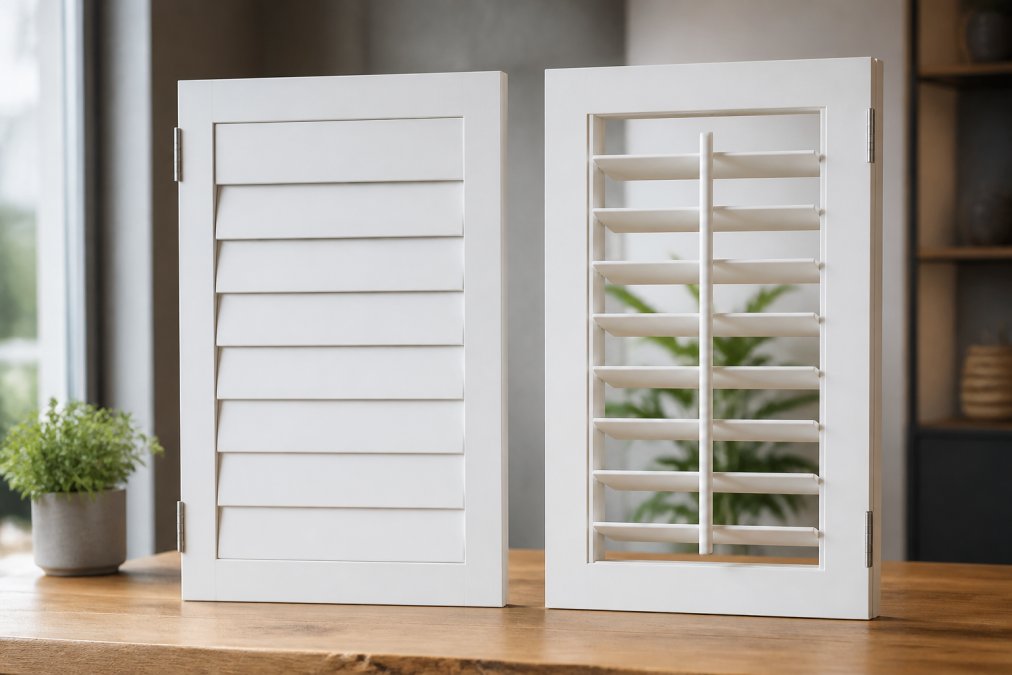
The practical differences come down to louvre width, frame profile, and how the panels are built into the opening. Narrower louvres and slimmer frames suit smaller sash windows in period properties. Wide louvres and deeper frames suit larger openings where you want maximum light control with fewer visible slats.
| Feature | Interior Shutters | Plantation Shutters |
|---|---|---|
| Category | Broad term for all internal shutter types | Specific style within interior shutters |
| Louvre width | Varies, often narrower | Typically wider louvres |
| Frame profile | Slim to standard | Deeper, more substantial |
| Best for | Sash windows, tight reveals, arched frames | Large bays, wide openings, high ceilings |
| Light control | Good with correct louvre choice | Excellent, fewer slats to adjust |
| Fit requirement | Must be made to measure | Must be made to measure |
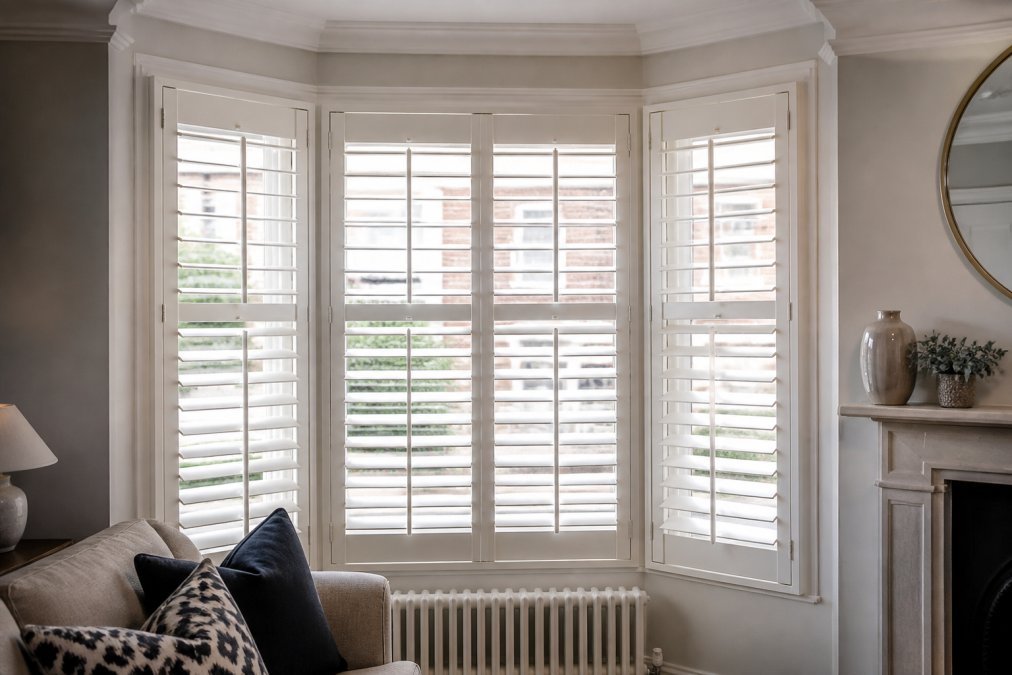
Plantation Shutters for Bay Windows: Why Fit Matters More Than Style
Bay windows present more challenges for shutter installations than any other frame type. A bay has three or more panels meeting at angles, and each angle needs its own frame section cut to the exact degree of the reveal. Get that wrong and the shutters bind, the louvres foul the frame, or the whole assembly sits proud of the wall.
This is where most cheap quotes fall down. A templated shutter is manufactured to a standard angle and trimmed on site. On a true Victorian or Edwardian bay, that approach produces gaps, sticking panels, and a finish that never looks intentional.
What most guides miss is that the angled side panels carry the load. They need to be measured independently from the front panel, because the reveals on older bays are rarely square or symmetrical. A common mistake is assuming the two side returns mirror each other. They almost never do.
Shutter Material Comparison: MDF vs Hardwood
MDF and hardwood are the two materials you will be offered, and the choice affects how the shutters handle moisture, weight, and paint finish over time.
MDF is a dense engineered board made from compressed wood fibres and resin. It takes paint evenly, resists warping in stable indoor conditions, and costs less than hardwood. The trade-off is weight and repairability: a deep chip cannot be sanded out the way it can on solid timber.
Hardwood is solid timber, usually a stable species chosen for internal joinery. It handles humidity swings better, can be sanded and refinished, and holds a paint or stain finish for decades. It costs more and weighs more, which matters on large bay panels where hinge strength becomes a factor.
| Material | Best For | Watch Out For |
|---|---|---|
| MDF | Stable rooms, standard windows, tighter budgets | Heavier panels, limited repair options |
| Hardwood | Period properties, humid rooms, long-term investment | Higher cost, needs solid hinge fixing |
A common approach is MDF in bedrooms and hallways, hardwood in bathrooms and kitchens where moisture swings are greater.
Bespoke Shutter Installation Costs: What Actually Drives the Price
Bespoke shutter installation costs are driven by window count and complexity, not by the shutter style you pick. A wide louvre and a narrow louvre on the same frame cost broadly similar amounts to make.
The variables that move a quote are the number of openings, whether any are bays, arches, or non-standard shapes, the material chosen, and the finish. An arched frame needs a curved frame section, which is a different manufacturing process from a straight cut. A bay with three angled returns takes longer to survey and longer to fit than three separate flat windows of the same total width.
Pricing depends on quantity, window complexity, and finish, so we do not publish fixed figures. The honest answer is that two homes on the same street can receive different quotes because their window reveals are different. Shutters West London provides a free home consultation and measurements, which is the only way to price a bespoke job accurately.
Made-to-Measure vs Off-the-Shelf: Where London Interiors Shutters Win
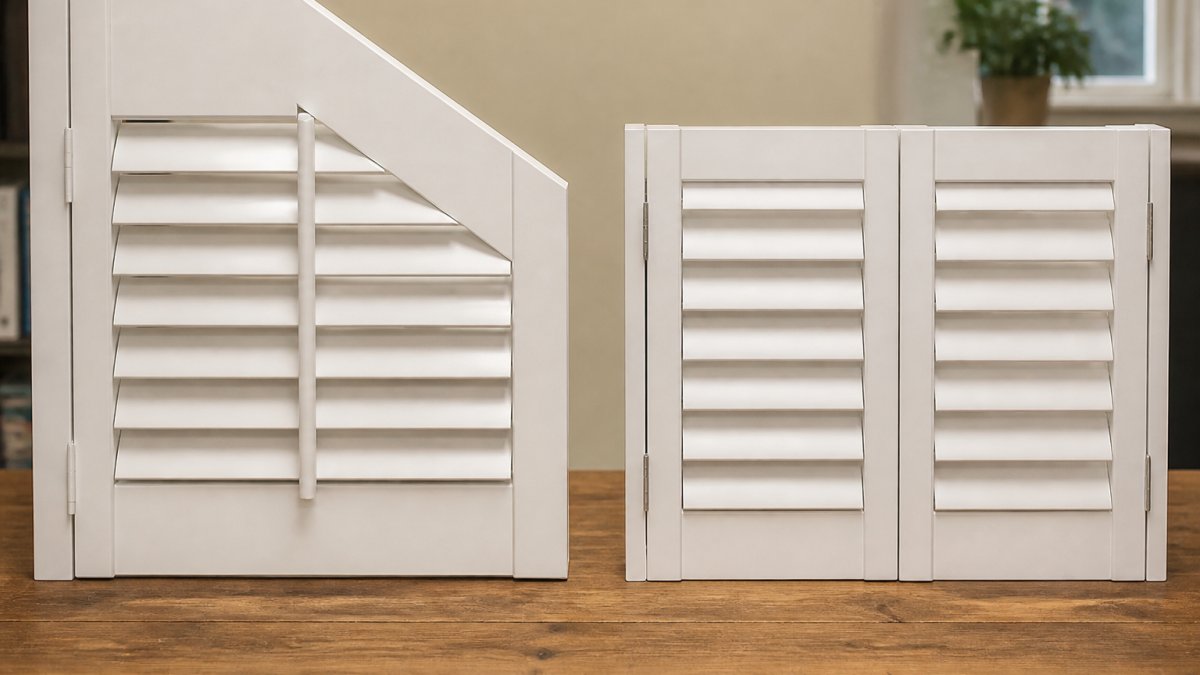
Off-the-shelf shutters only work on standard rectangular openings with square reveals. The moment a window is out of square, has an arched top, or sits in a bay, an off-the-shelf panel leaves gaps at the edges that no amount of trimming fixes cleanly.
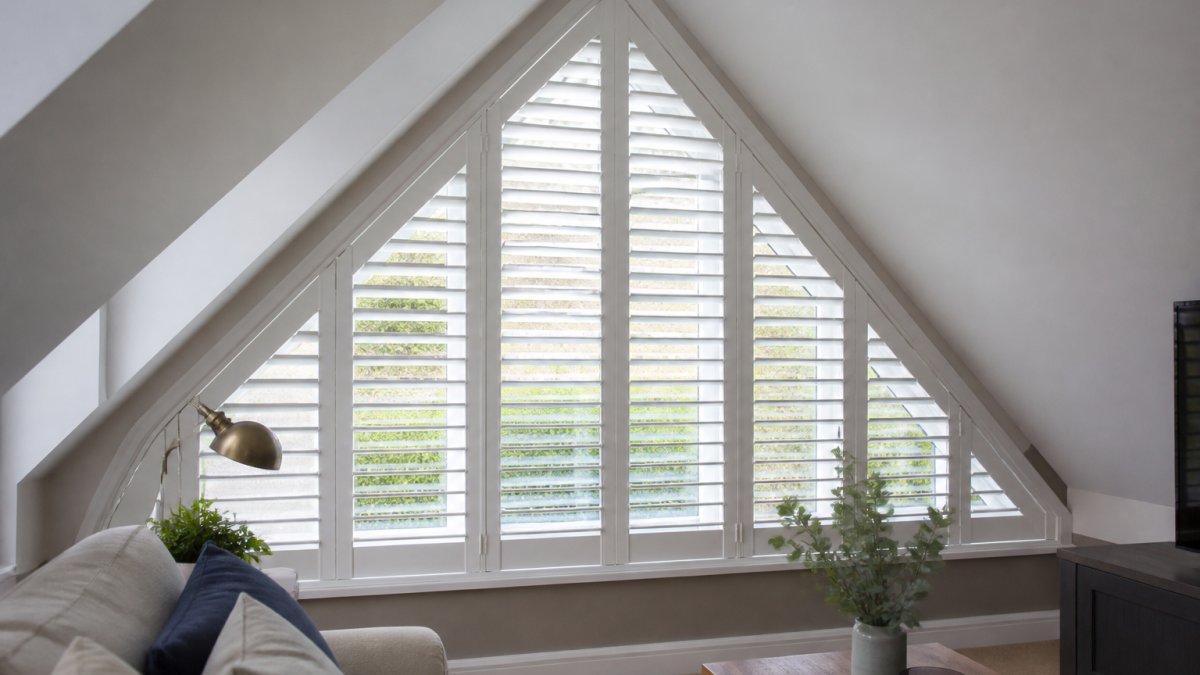
Made-to-measure interior shutters are built to the actual opening. Every set is made from scratch rather than adapted from a stock size, which is the only way to handle the arched and awkward frames common in period housing stock. The panels sit flush, the louvres clear the frame, and the reveal is covered properly rather than packed out with filler.
This is the point where the two categories genuinely separate. If your windows are standard and square, an off-the-shelf option can work. If they are not, made-to-measure is not a premium upgrade, it is the only option that fits.
Which Shutter Type Suits Your Home? A Decision Framework
Use this framework to narrow the choice before you request a survey.
- Measure the widest and narrowest point of each opening. If they differ by more than a few millimetres, you need made-to-measure.
- Count the angled returns on any bay. Each one is a separate frame section.
- Check for arched or shaped tops. These require curved frame manufacturing.
- Note which rooms have high moisture. Specify hardwood there.
- Decide your priority: maximum light control favours wider louvres; a lighter look favours narrower ones.
- Confirm the quote includes an in-home survey of the actual angles, not just a width and drop measurement.
If you tick more than one of the first three boxes, you are in made-to-measure territory, and the style question becomes secondary.
Conclusion
The real challenge with shutters is not choosing between two styles, it is finding a fit that survives a period bay, an arched frame, or a reveal that is slightly out of square. Get that wrong and no material or louvre width will save the result.
Shutters West London has spent 30 years as a family-run workshop making every set from scratch, never from a template. We offer a free home consultation and measurements, complete personalisation of styles, colours, and tilt rods, and full light control with optional blackout features. Our 10/10 Checkatrade rating across all reviews reflects how we work.
Get started with Shutters West London and have your windows measured properly before you commit to a style.
Frequently Asked Questions
What is the difference between interior shutters and plantation shutters?
Interior shutters is a broad term for any window shutter fitted inside the home, while plantation shutters are a specific style with wide louvres set in a solid frame, originally used on plantations to control airflow. In practice, most London interior shutters sold today are plantation-style. The real distinction for buyers is construction quality: whether the panels are made to measure from scratch or cut from a standard template, and whether the frame is built to suit your window's exact shape.
Do plantation shutters work well for bay windows?
They can work very well, but only when each of the bay's angled panels is measured and built individually. A three-sided or five-sided bay needs separate frames that meet cleanly at the corners, and arched or Victorian curved tops need bespoke shaping rather than a standard rectangular panel. Shutters cut from a template often leave gaps at the angles, which shows in daylight and lets draughts through. Made-to-measure plantation shutters for bay windows solve this because every panel is built for its own section of the frame.
Are plantation shutters a good investment for property value?
Shutters are a fixed improvement rather than a movable one, so they stay with the property when it sells and can be listed as a feature. Their value rests on durability: a well-built hardwood or quality MDF set fitted correctly can last decades with basic cleaning, while cheaper sets that warp or stick after a few years add nothing. Buyers of period properties in particular tend to view well-fitted shutters as part of the home's character, not an afterthought.
How do bespoke shutters differ from off-the-shelf alternatives?
Off-the-shelf shutters come in set sizes and are trimmed to fit on site, which limits how closely they follow an awkward frame. Bespoke shutters are measured at your window, then each panel, frame and louvre is made to those exact dimensions. That difference matters most on bay, arched and uneven period windows, where a few millimetres of gap is visible and lets light and cold air past the frame. Bespoke also lets you choose the finish, tilt rod position and hinge colour to match the room.
What materials are best for plantation shutters in humid rooms?
For bathrooms and kitchens, a water-resistant material such as quality MDF with a sealed finish or a hardwood with a proper moisture-resistant coating holds up better than untreated timber. Solid hardwood gives the most premium look and can be sanded and refinished, but it needs a protective finish in damp rooms. MDF is dimensionally stable and does not swell the way some softwoods can, which is why it is common in wet areas. Ask what finish is applied, not just what the core material is.