 how-to
Bay Window Curtain Solutions: A Fitting Guide
Table of Contents
- Understanding Your Bay Window Curtain Options
- Measuring Bay Windows for Curtain Tracks Accurately
- How to Measure Arched Windows for Custom Fittings
- Selecting the Right Track System for Your Bay
- Bespoke Plantation Shutters for Bay Windows
- Step-by-Step Installation Process
- Common Installation Mistakes to Avoid
- Frequently Asked Questions
Last Updated: September 25, 2026
Understanding Your Bay Window Curtain Options
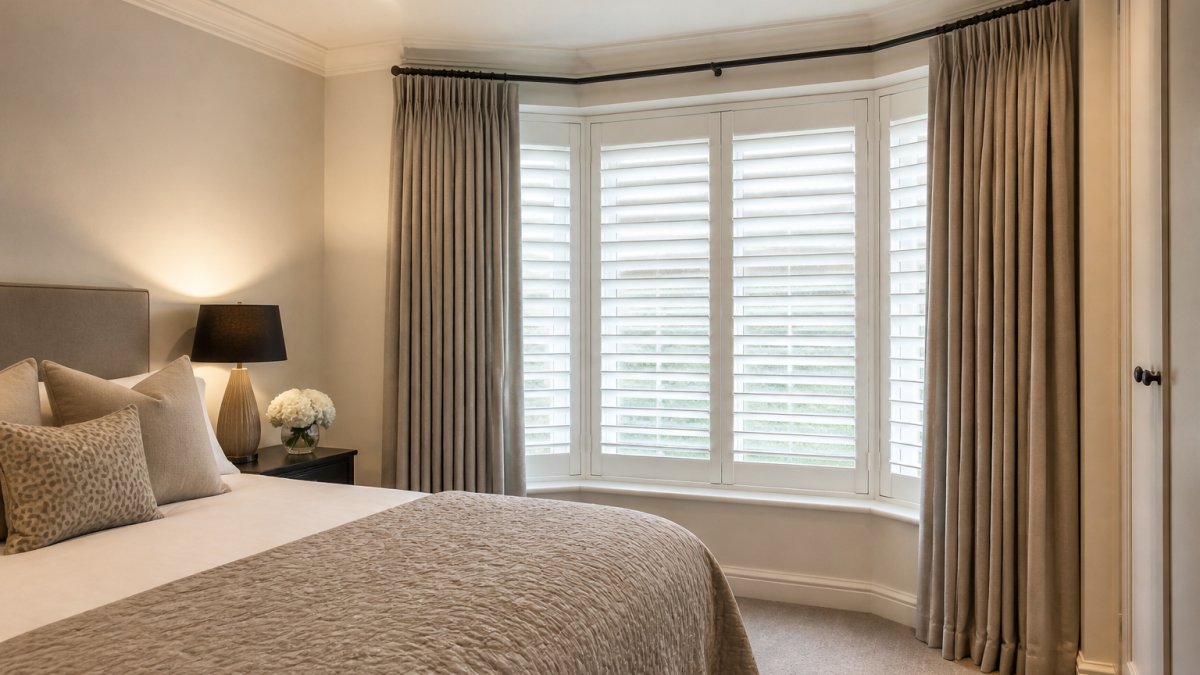
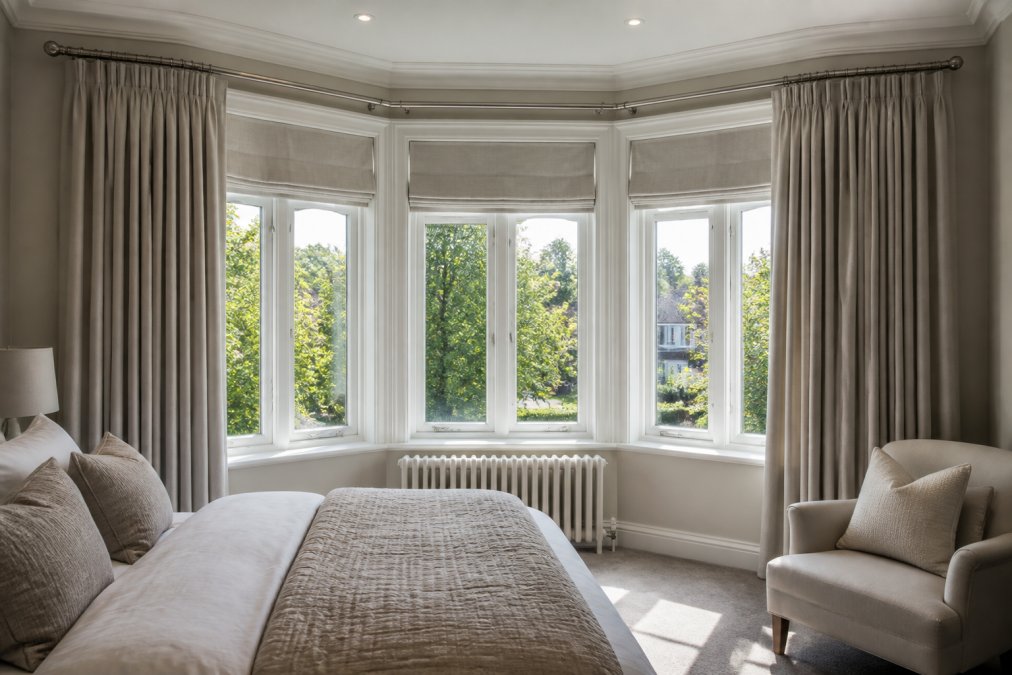
Bay windows present a unique challenge, and finding effective bay window curtain solutions requires understanding your options. They jut out from the wall at angles, creating multiple planes that standard curtain solutions simply don't fit. The good news: there are several proven approaches, each suited to different preferences and budgets.
Your main options fall into these categories:
- Flexible or bendable tracks that curve to follow your bay's shape
- Segmented track systems with corner joints for a more structured fit
- Individual blinds or shutters fitted to each window pane separately
- Bespoke plantation shutters custom-made to your exact bay geometry
The choice depends on three factors: the angle of your bay, how much light control you need, and whether you prefer a traditional or contemporary look. At Shutters West London, we've spent 30 years working with period properties, and we've learned that what works beautifully in one bay doesn't always suit another.
Measuring Bay Windows for Curtain Tracks Accurately
Getting measurements right is non-negotiable. A small error here creates problems that become obvious every time you open or close your curtains.
Taking Width and Depth Measurements
Start with the width. Measure across the widest part of your bay at three points: top, middle, and bottom. Bay windows often aren't perfectly square, so these measurements may differ slightly. Record all three.
Next, measure the depth, how far the bay projects from the wall. Measure from the wall to the furthest point of the bay. You'll need this to ensure your curtain poles or tracks don't protrude into the room awkwardly.
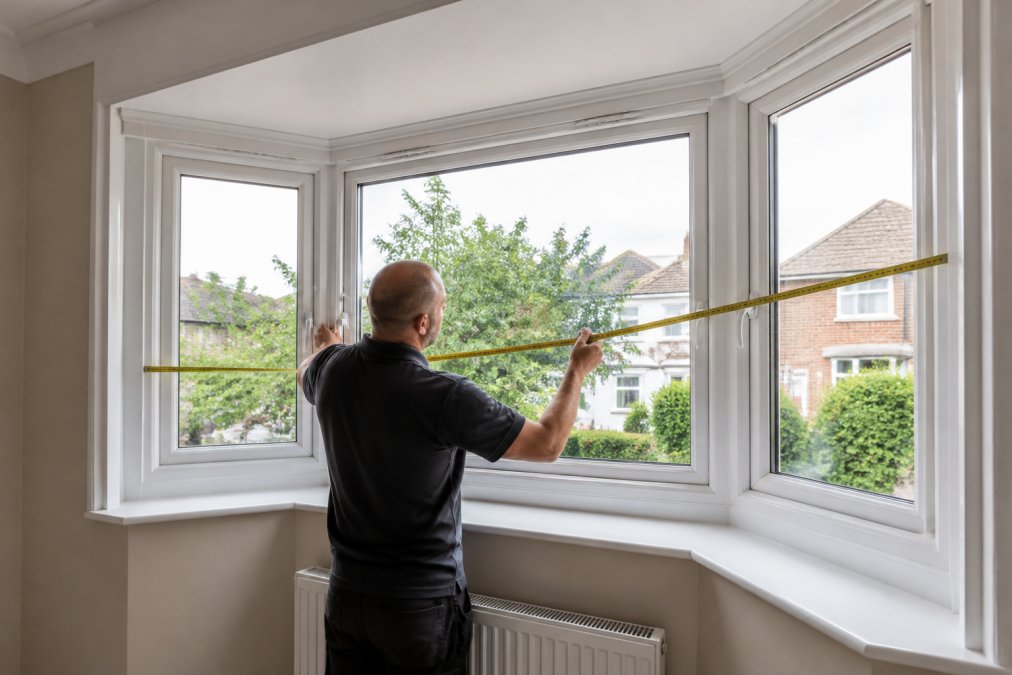
Write everything down. Don't rely on memory. A notebook or phone photo of your measurements prevents costly mistakes when you're ordering tracks or curtains.
Accounting for Bay Angles and Corners
The angles are where most people struggle. A typical bay has two or three angled corners. Each corner needs its own measurement.
For a standard three-sided bay:
- Measure the angle where the front pane meets each side pane
- Use an angle finder tool (available cheaply from hardware shops) or a smartphone app
- Note the angle in degrees, this determines which track systems will work
If your bay has a curve instead of sharp angles, measure the radius of the curve. A flexible track system handles curves well. Sharp angles need segmented tracks with proper corner joints.
The depth at each corner also matters. Some bays project further at the corners than at the front. This affects how far your brackets need to extend from the wall.
Take your time here. These measurements determine whether your curtain solution will look professional or makeshift. Most track suppliers need this detail before they can give you an accurate quote.
How to Measure Arched Windows for Custom Fittings
Arched or curved bay windows demand a different approach. You can't use standard straight tracks, they'll gap away from the frame.
For an arched window, you need to understand the curve. Measure the span of the arch (the widest point) and the height from the base to the peak. If the arch is gentle, a flexible track might work. If it's pronounced, you'll likely need a custom-bent track or individual shutters for each section.
The radius of the curve is the key measurement. If you imagine the arch as part of a circle, the radius tells you how tight or gentle that circle is. A shallow curve (large radius) is easier to fit. A tight curve (small radius) requires more specialised solutions.
Many homeowners find that arched windows work best with bespoke plantation shutters rather than curtains. Shutters follow the curve perfectly because they're made to your exact measurements. Curtains, even with flexible tracks, can look slightly off in a pronounced arch.
If you're set on curtains for an arched window, ask your track supplier whether they offer custom-bent options. Some do, but it costs more than standard segmented tracks.
Selecting the Right Track System for Your Bay
Once you've measured, you need to choose between track types, a crucial step in selecting the right bay window curtain solutions for your space. This decision shapes how your curtains hang and how smoothly they operate.
Flexible and Bendable Tracks
Flexible tracks bend smoothly to follow your bay's contours. They work well for gentle curves and moderate angles. The track itself is made from a flexible material that takes the shape you need.
These tracks have real advantages:
- Simple installation if you're confident with tools
- Smooth, quiet operation
- A clean look with minimal visible hardware
- Suitable for lightweight to medium-weight curtains
The downside is that they can sag slightly under heavy fabric. For floor-to-ceiling curtains in a large bay, you might need additional support brackets midway along the track.
Flexible tracks typically cost less than segmented systems. If your bay has a gentle curve or shallow angles, this is often the most practical choice. Silent Gliss and similar premium brands offer flexible bay window tracks that operate beautifully for years.
Segmented Track Systems
Segmented tracks use separate straight sections connected at corners with hinged or angled joints. Each section is rigid, which means they handle heavy curtains better than flexible tracks.
These systems work well for:
- Bays with sharp, defined angles
- Heavy curtains or multiple layers
- Situations where you want maximum smoothness and reliability
The joints at corners are the critical point.
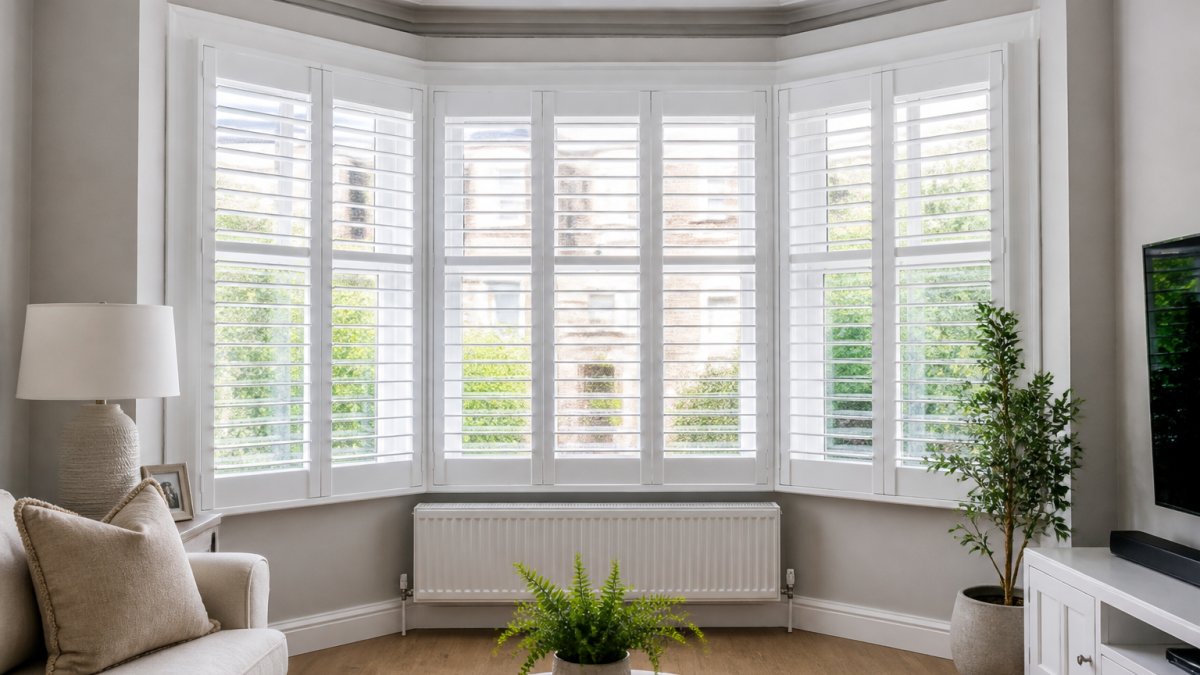
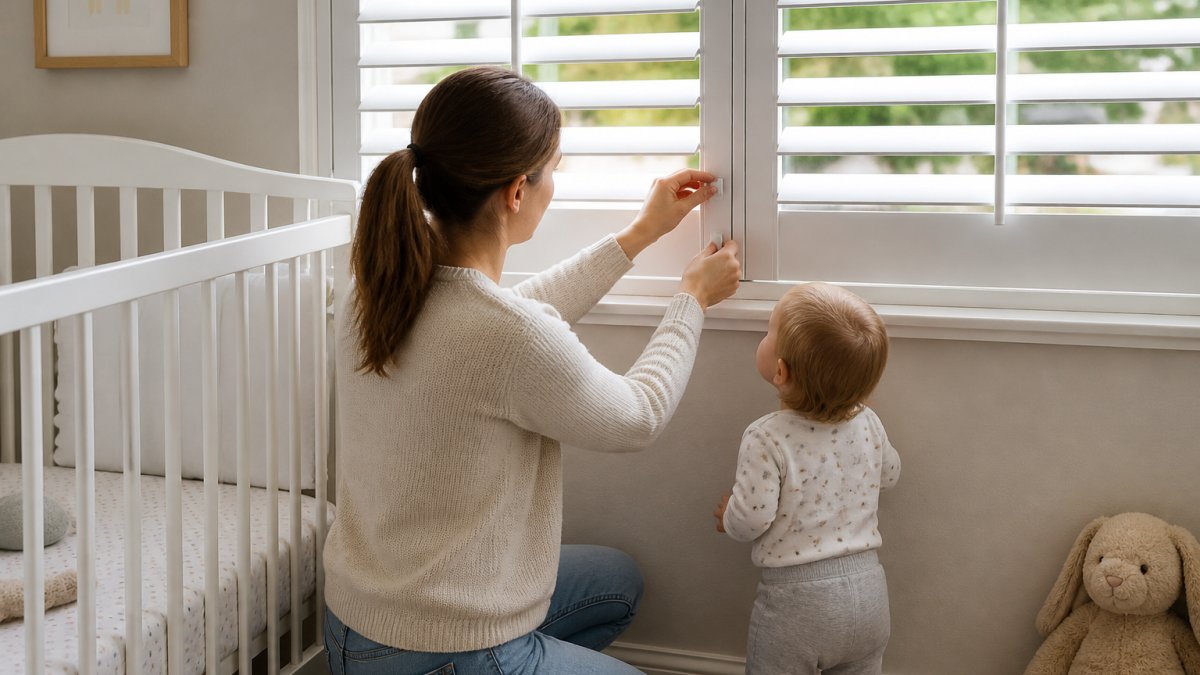
Bespoke Plantation Shutters for Bay Windows
Shutters offer a completely different approach. Instead of hanging fabric on a track, you fit rigid panels to each window section.
For bay windows, shutters have distinct advantages:
- They follow any angle or curve perfectly because they're made to measure
- They provide superior light control, you adjust each louvre independently
- They add real value to your property
- They last decades with minimal maintenance
- They suit period properties beautifully
The process is straightforward:
- Free home consultation where we measure your bay precisely
- Design consultation to choose colours, finishes, and louvre styles
- Your shutters are handcrafted in our workshop
- Professional installation by our team
Step-by-Step Installation Process
Once you've chosen your solution, installation is the next hurdle. The process varies depending on whether you're fitting tracks or shutters.
Preparing Your Bay Window
Start by clearing the space. Remove any existing curtain poles, blinds, or shutters. Clean the window frame thoroughly, dust and debris prevent brackets from sitting flush.
Mark your bracket positions lightly with pencil. For a bay window, you typically need:
- One bracket at each corner
- Additional brackets along longer runs (roughly every 60cm)
- Brackets positioned so they're hidden when curtains are closed
Fitting Brackets and Hardware
Drill pilot holes at your marked positions. Use the correct drill bit size for your wall type, masonry needs a different bit than plaster.
Hanging and Testing Your Curtains
Fit your curtain runners or gliders to the track. Slide them along the full length to ensure smooth operation. They should move freely without catching.
Common Installation Mistakes to Avoid
Most problems stem from rushing the measurement or installation phase.
Frequently Asked Questions
How do I measure a bay window for curtains accurately?
Start by measuring the width of each straight section and the depth from the wall to the outermost point. Use a steel tape measure, not a fabric one. Measure at three heights (top, middle, bottom) to account for uneven frames. For the angles, note the degree of bend or use a protractor. Measure twice and note all dimensions clearly. If the bay has more than three sides, measure each section individually. Professional measurement services ensure precision, especially for complex period properties.
What's the difference between bespoke plantation shutters for bay windows and standard curtain solutions?
Bespoke plantation shutters are custom-made to fit your exact bay geometry, offering superior light control, privacy, and durability. Unlike curtains, shutters don't collect dust, require no regular washing, and work with any decor style. They provide better insulation and can last decades with minimal maintenance. Curtains offer more flexibility in changing looks seasonally and are generally less costly upfront, but shutters add lasting value and character to period properties.
Can I use a single curtain track for a bay window, or do I need separate tracks?
Most bay windows work best with either a single bent track or multiple segmented tracks depending on the angle. A flexible track bends smoothly around gentle curves, ideal for shallow bays. Segmented or angled tracks work better for sharp corners. Separate tracks for each section give you independent control but create visible joins. Your choice depends on the bay's shape, the curtain weight, and your aesthetic preference. Professional consultation helps determine the best approach for your specific window.
How do I measure an arched window for custom fittings?
For arched windows, measure the width at the base and the height from base to the arch's highest point. Mark the arch curve using a flexible ruler or bendable measuring tape, tracing the exact line. Take measurements at regular intervals (every 10-15 centimetres) along the curve to capture its precise shape. Photograph the measurements and the window itself. Arched windows often require bespoke solutions because standard tracks won't follow the curve. Providing detailed measurements and photos to a specialist ensures a perfect fit.