 how-to
How to Childproof Plantation Shutters for Nursery Rooms
Table of Contents
- Why Nursery Shutters Need Childproofing From Day One
- What You'll Need Before You Start
- How to Childproof Window Treatments Step by Step
- How to Secure Plantation Shutters: Tilt Rods, Panels and Frames
- Plantation Shutter Safety Checks for Every Nursery
- Blackout Options for Nursery Shutters
- Common Mistakes to Avoid
- Conclusion
- Frequently Asked Questions
Last Updated: October 21, 2026
Why Nursery Shutters Need Childproofing From Day One
Childproof plantation shutters are one of the safest window dressings you can put in a nursery. There are no dangling cords for a baby to reach, and the slats stay fixed in their frame. But "safer than curtains" is not the same as "safe." The shutters themselves are sound, but the small parts and the way they move need attention before a cot goes anywhere near the window.
The risks are simple to understand. Tilt rods can be pulled, panels can swing, and little fingers can find gaps. A few cheap fixes remove almost all of that risk.
Here is how to childproof plantation shutters so the nursery stays safe from the first night.
What You'll Need Before You Start
Gather your kit first so you are not climbing around a sleeping baby looking for a screwdriver. Most of these items cost very little and are sold at any hardware shop.
- A tape measure
- Child safety clips or tilt rod covers
- Adhesive cable clips or small L-brackets
- A screwdriver that matches your shutter screws
- A magnetic cupboard catch or two
- A stud finder, if you plan to fix anything to the wall
- A soft cloth for cleaning before you stick anything down
How to Childproof Window Treatments Step by Step
Childproofing window treatments means removing anything a child can pull, trap a finger in, or climb. For shutters, that comes down to five steps you can finish in under an hour.
- Measure the gap between the shutter frame and the wall, and check the tilt rod length.
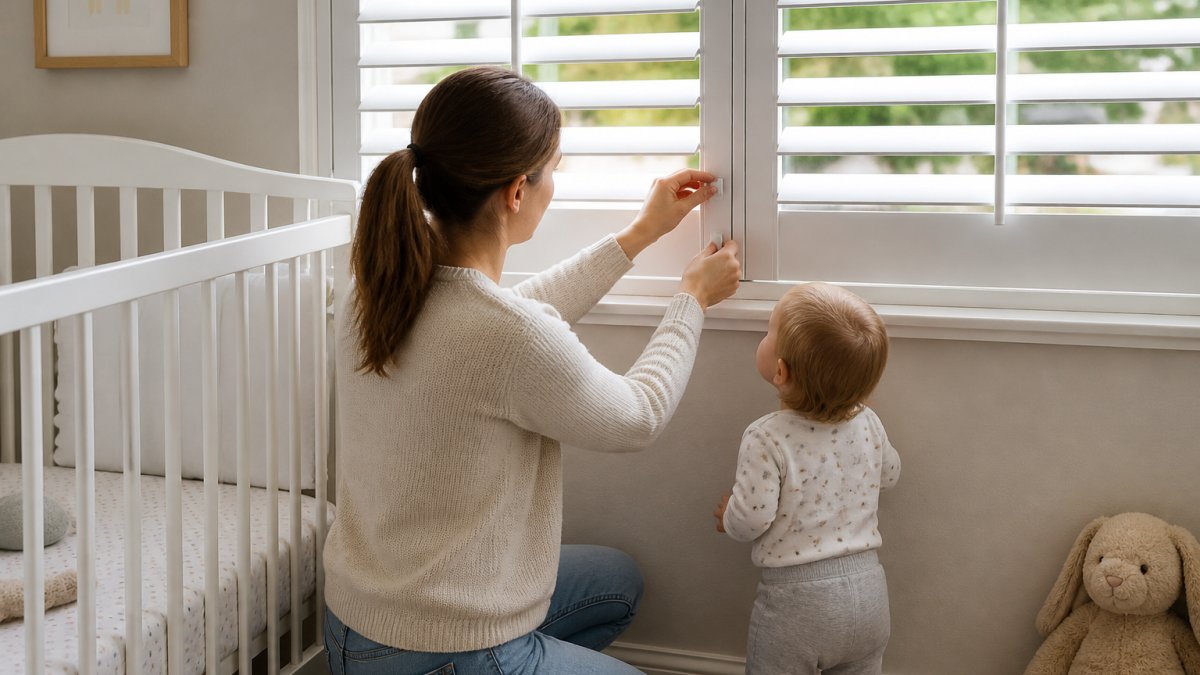
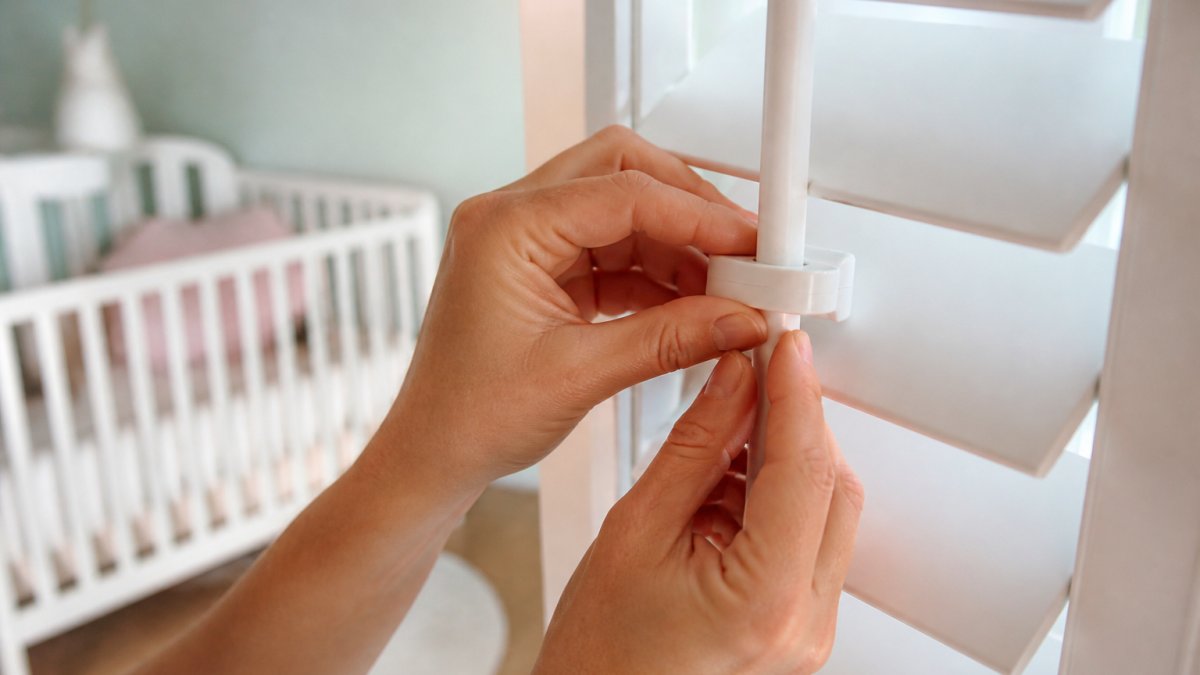
- Fit child safety clips to the tilt rod so the slats cannot be forced open or shut.
- Secure loose panels with a small magnetic catch or an L-bracket at the top.
- Check for sharp edges and cover any exposed screws.
- Confirm the window itself has a working restrictor and that no furniture sits under the sill.
Work through the list with the cot moved away from the window. Once everything is fitted, test each part by hand. If a clip moves when you tug it, it will move when a toddler tugs it too.
How to Secure Plantation Shutters: Tilt Rods, Panels and Frames
Securing plantation shutters comes down to three parts: the tilt rod, the panels, and the frame. Each needs a slightly different approach.
Tilt rods. These are the rods you twist to open the slats. They are the most tempting part for small hands. Fit a purpose-made tilt rod cover or a safety clip so the rod cannot be turned freely. On some designs, a clip at the top and bottom of the rod is enough.
Panels. Hinged panels can swing open. A magnetic catch fitted to the frame stops a panel from being pushed wide. For fixed panels, check that the screws holding them are tight.
Frames. Make sure the frame is fixed firmly to the wall or window recess. If it flexes when pushed, it needs a stronger fixing. This is where a made-to-measure frame helps.
Plantation Shutter Safety Checks for Every Nursery
Run through these plantation shutter safety checks each month, and again any time you move furniture around the room.
- Tug each tilt rod clip to confirm it holds
- Check panel hinges for looseness or squeaks
- Look for gaps at the frame edges
- Confirm no cot, changing table, or toy box sits under the window
- Check that blind or window restrictors still work
- Wipe away dust and check adhesive clips are still stuck
A quick two-minute check catches most problems before they become a hazard. If you spot a screw that keeps working loose, that is a sign the fixing is not right, not a sign to tighten it and forget it.
Blackout Options for Nursery Shutters
Blackout options for nursery shutters matter because naps and early bedtimes depend on a dark room.
The practical answer is a blackout blind fitted behind the shutters, or a blackout lining built into the shutter design. Check that any blind you add has no hanging cords, or fit a cordless version. Cord safety is not optional in a nursery.
If you are ordering new shutters, ask about blackout features at the design stage. It is far easier to build light control in from the start than to add it later.
Common Mistakes to Avoid
The biggest mistake is treating shutters as automatically child-safe and skipping the checks. A few others come up again and again:
- Fitting clips to a dusty frame, so they fall off
- Leaving the cot directly under the window
- Using a corded blackout blind instead of a cordless one
- Ignoring a frame that flexes when pushed
- Forgetting to recheck after moving furniture
Conclusion
Getting a nursery safe takes a little planning, but the fixes for shutters are quick and cheap. Measure, fit clips to the tilt rods, secure the panels, and keep the cot away from the window.
If you want shutters that fit properly from the start, with no gaps and no wobble, that is what we do. Shutters West London offers 100% made-to-measure plantation shutters, a free home consultation and measurements, and optional blackout features for full light control. With 30 years of family-run craftsmanship and a 10/10 Checkatrade rating, we build every set from scratch to fit your windows exactly.
Get started with Shutters West London and give your nursery a safe, made-to-measure finish. Request your free quote today.
Frequently Asked Questions
Are plantation shutters safe for a nursery?
Plantation shutters are generally a safe choice for a nursery, and often safer than curtains or blinds with long cords. The main risks come from loose tilt rods, unsecured panels and gaps a toddler could reach through. Once you secure plantation shutters with clips or a cordless tilt mechanism, check fixings every few months and choose a blackout option that does not add trailing cords, they work well in a baby's room. A made-to-measure fit also removes the gaps and wobble that come with poorly fitted frames.
How do you childproof plantation shutters?
Start by removing or covering any hanging tilt rod, then fit a child-safe tilt clip or switch to a cordless wand mechanism. Check that the panels are locked into the frame and that hinge screws are tight. Recheck fixings every three to six months, especially once your child starts pulling up on furniture near the window.
Can a child pull plantation shutters off the wall?
A well-fitted shutter frame screwed into a solid wall or window reveal is very hard for a child to pull off. The risk rises when frames are held only by light fixings, when hinges are loose, or when a toddler uses the bottom louvres as a step. Check hinge screws regularly. If you can wobble the frame by hand, secure plantation shutters properly before the nursery is used.
Can plantation shutters make a nursery darker for sleep?
Yes. Plantation shutters block light well because the louvres close tight against the frame, and blackout options for nursery shutters include integrated blackout blinds. A made-to-measure fit matters most, since light leaks around the edges of a loose frame will undo much of the benefit. If your nursery faces a streetlight or early summer sun, ask for a blackout specification at the consultation stage rather than adding a separate blind later.