 ultimate-guide
Bay Window Treatments for Kitchens: A 2026 Guide
Table of Contents
- Why Bay Window Treatments Matter in Kitchen Design
- Bespoke Plantation Shutters for Kitchens
- How to Measure Bay Windows for Shutters
- Waterproof Kitchen Window Shutters: Durability and Maintenance
- Light Control and Privacy with Bay Window Shutters
- Common Mistakes When Choosing Bay Window Treatments
- Conclusion
- Frequently Asked Questions
Last Updated: September 24, 2026
Why Bay Window Treatments Matter in Kitchen Design
Bay windows are architectural assets that flood kitchens with natural light and create visual depth. Yet they present a challenge most homeowners underestimate: finding window treatments that actually fit their irregular angles and curves. Standard off-the-shelf solutions rarely work. A bay window's geometry demands precision, and that's where bay window treatments kitchen design becomes critical to both function and aesthetics.
The real problem isn't finding treatments, it's finding ones that work with the space rather than against it. Kitchens are high-moisture, high-use environments. Whatever you install needs to handle steam from cooking, resist warping, and operate smoothly for years. Most mass-produced options fail on at least one of these fronts.
At Shutters West London, we've spent three decades solving exactly this problem. Our approach is straightforward: measure once, build custom, install perfectly. No templates, no compromises. Whether your bay window catches morning light or faces a neighbour's fence, the treatment should respond to your actual situation, not squeeze into a manufacturer's standard size chart.
The British Institute of Interior Design emphasises that window treatments significantly influence both room functionality and property value. The right choice transforms a kitchen from purely practical into genuinely beautiful.
Bespoke Plantation Shutters for Kitchens
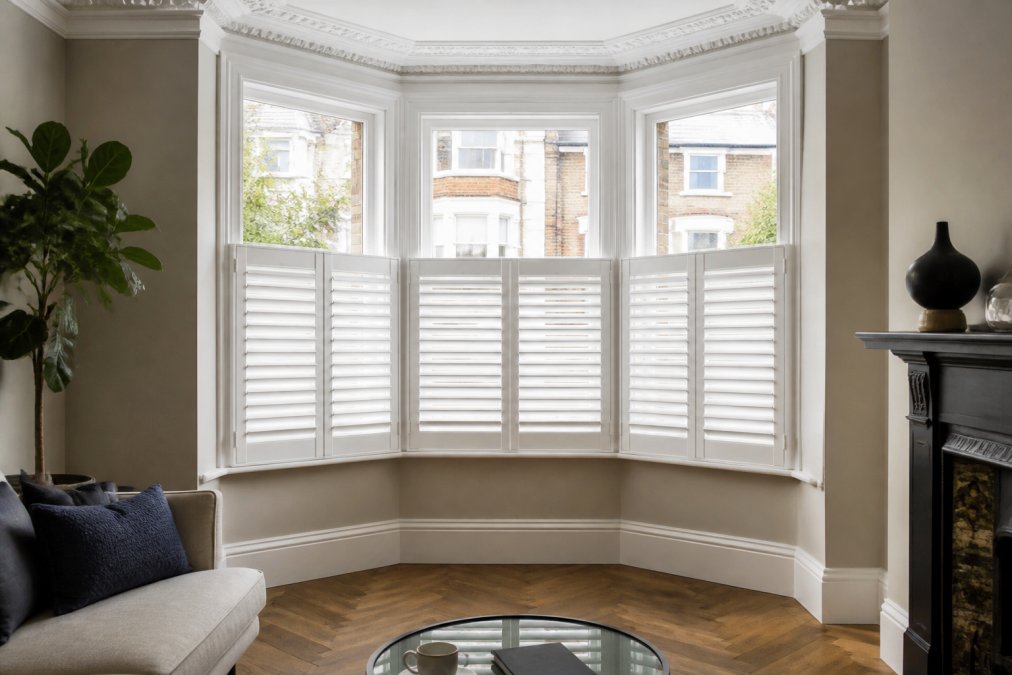
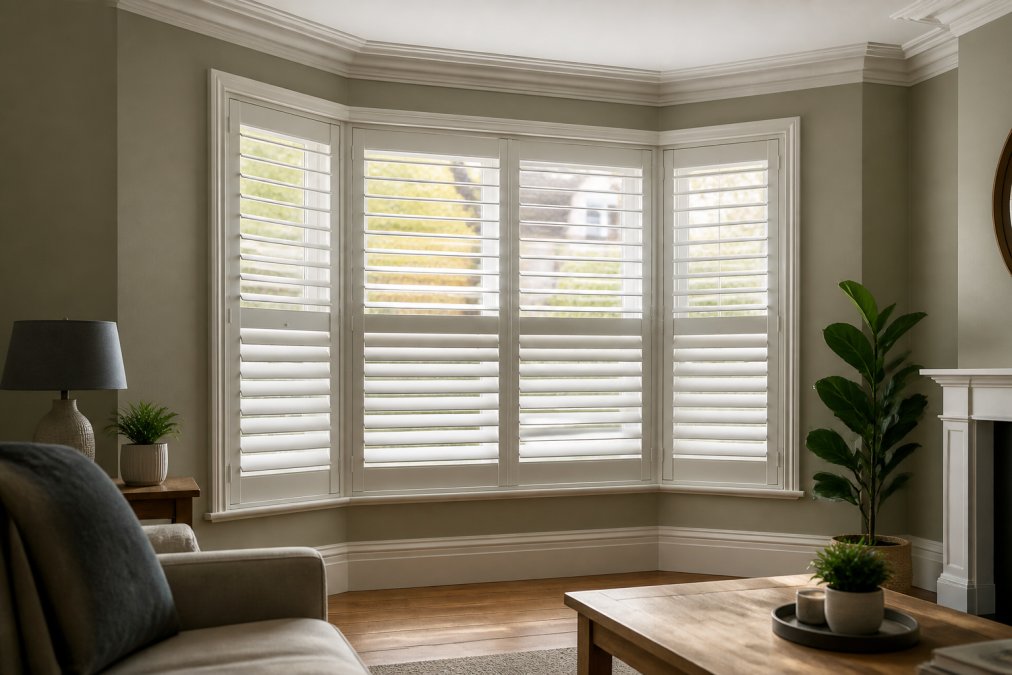
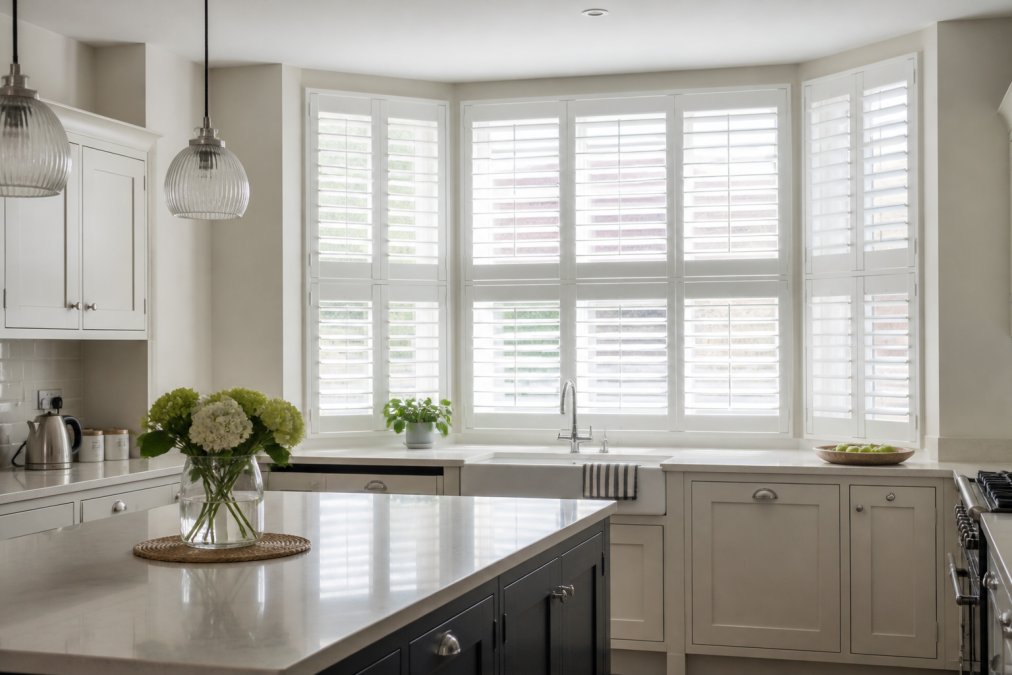
Bespoke plantation shutters for kitchens represent the gold standard for bay window treatments because they combine adjustable light control with durability and style that lasts decades. Unlike fabric curtains or roller blinds that degrade in humid kitchen environments, plantation shutters are engineered to perform in demanding spaces.
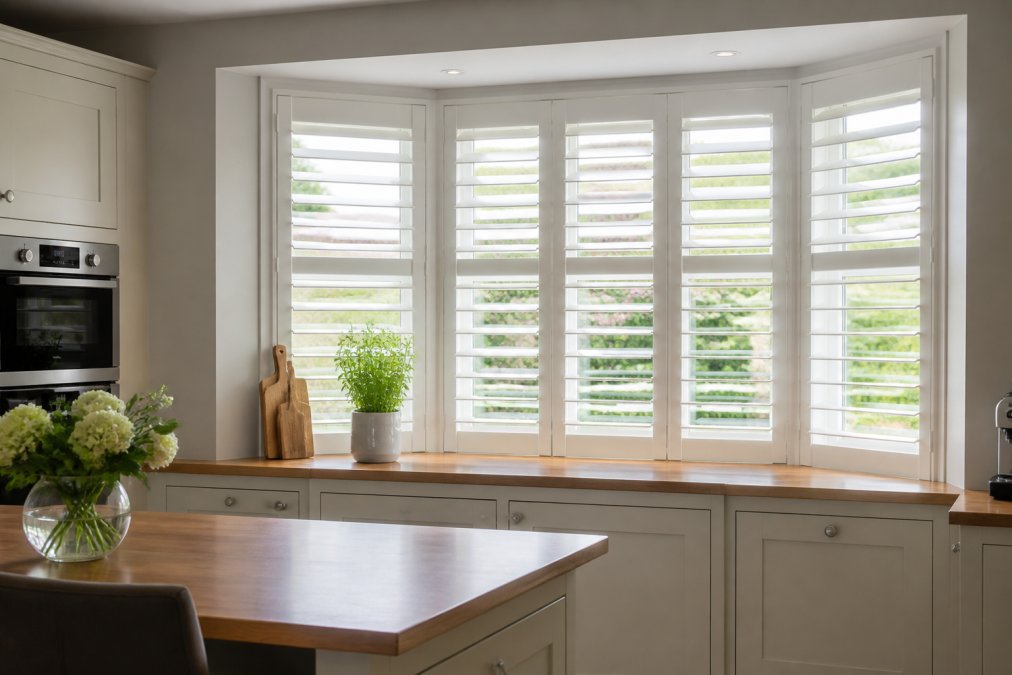
Plantation shutters work through a simple mechanism: vertical stiles and horizontal louvres that tilt independently to adjust light and privacy. In a kitchen bay, this matters because you control exactly how much morning sun hits your worktop, whether you're cooking or eating. The louvres close completely for blackout when needed, or open fully to maximise daylight without losing privacy.
The durability advantage is substantial. Shutters resist moisture, don't absorb cooking odours, and require only occasional dusting or a wipe with a damp cloth. Compare that to fabric treatments that trap steam, harbour grease residue, and deteriorate within five years in a busy kitchen.
Customisation is where bespoke plantation shutters for kitchens justify their premium position. You choose louver width, frame colour, tilt-rod placement, and panel configuration. A bay window with three angles demands three separate shutter sets, each measured and built to fit its exact geometry. That precision is impossible with stock products.
How to Measure Bay Windows for Shutters
Measuring how to measure bay windows for shutters correctly is the foundation of a successful installation. Incorrect measurements create gaps, misaligned panels, or shutters that bind when you try to close them. Get this right and the installation process becomes straightforward.
Start by identifying how many facets your bay contains. Most bays have three sections (two angled sides and a centre), but some have four or five. Each facet is a separate measurement because bay angles vary, rarely do they form perfect 90-degree corners.
For each section, measure the width at three points: top, middle, and bottom. Bay windows often aren't perfectly plumb, so these three measurements can differ by several millimetres. Record the smallest width, this ensures your shutters won't bind. Measure the height at three points as well: left, centre, and right of each facet.
Depth matters too. Measure from the window glass to the deepest point of your reveal (the recessed area around the window). This determines whether your shutters sit flush with the wall or project slightly outward. Kitchen bays often have shallow reveals, which affects how panels open and close.
Many homeowners attempt this alone and miss critical details. A professional measurement catches issues like out-of-square reveals, uneven sills, or architectural quirks that demand special solutions. Shutters West London includes a free home consultation and measurement as part of the process. We photograph the bay, take detailed measurements, and discuss exactly how the shutters will operate in your space.
Waterproof Kitchen Window Shutters: Durability and Maintenance
Waterproof kitchen window shutters are engineered for moisture resistance because kitchens generate steam from cooking, washing, and heating. Standard wood shutters swell and warp under sustained humidity. Quality kitchen shutters use materials and finishes designed for moisture resistance, and hardware designed not to rust.
The material choice is critical. The material choice is critical. The finish seals the wood and prevents water absorption.
Hardware must be designed to resist corrosion.
Maintenance is straightforward and infrequent. Wipe shutters monthly with a soft, slightly damp cloth to remove dust and cooking residue. Avoid harsh cleaners, mild soap and water suffice. Check tilt rods and hinges annually; a tiny amount of silicone lubricant keeps them operating smoothly. That's genuinely it. No repainting, no fabric replacement, no seasonal storage.
Light Control and Privacy with Bay Window Shutters
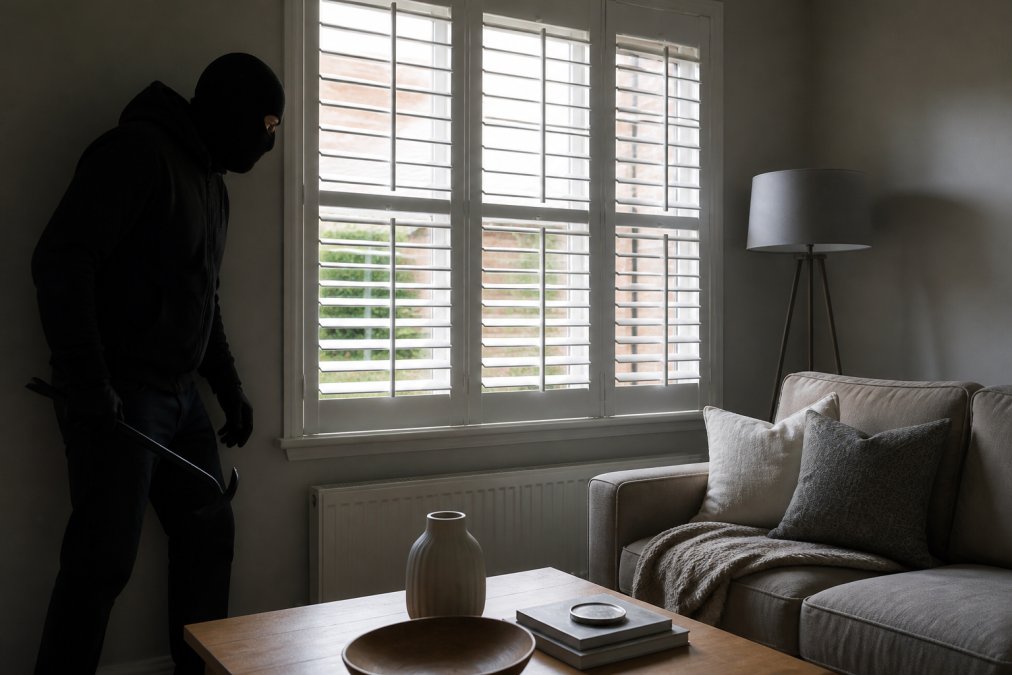
Bay windows present a privacy paradox: they're visually prominent from the street, yet you want natural light inside. Shutters solve this by offering independent control over each louvre. You can angle them to admit light while blocking direct sightlines, or close them completely for total privacy.
The tilt-rod mechanism is what makes this possible. A central rod connects all louvres in a panel, so moving it adjusts every louver simultaneously. This means you're not manually tilting 20 individual slats, one movement controls them all. In a three-section bay, you can set each section differently: one open for light, one partially closed for privacy, one fully closed to block an unsightly view.
Blackout capability matters in kitchens more than most rooms realise. Fully closed shutters eliminate light almost completely. This is particularly valuable in north-facing bays where light angles make privacy difficult with other treatments.
Louvre width affects both light control and privacy perception. The choice depends on your aesthetic preference and how precisely you want to adjust light throughout the day.
A bay's geometry creates natural privacy challenges. If your bay faces a busy street or neighbouring property, the angled sections can expose interior activity at certain times of day. Shutters let you close specific facets while keeping others open, something no other treatment achieves as elegantly.
Common Mistakes When Choosing Bay Window Treatments
Mistake one: treating the bay as a single unit rather than separate sections. This leads to ordering one large shutter set that doesn't fit any of the three facets properly. Each angle needs independent measurement and construction.
Mistake two: prioritising cost over durability in a kitchen environment. Spending more initially saves money over time and eliminates frustration.
Mistake three: overlooking maintenance requirements before purchasing. Fabric treatments demand regular cleaning in kitchens; wood shutters demand almost none. Understanding this difference prevents buyer's remorse.
Mistake four: forgetting to account for how shutters operate in a bay. Panels need clearance to open fully. If your bay has a radiator, deep windowsill, or architectural feature, it might block panel swing. Professional consultation identifies these issues before installation.
Mistake five: assuming all bespoke shutters are equivalent. There's a vast difference between a template-based "custom" shutter and one truly built from scratch for your specific bay. Template-based options are cheaper but often require compromise, gaps, binding panels, or aesthetic compromises.
Conclusion
Bay window treatments in kitchens require more thought than standard windows because the geometry is complex and the environment is demanding. Bay window treatments kitchen design isn't just about aesthetics, it's about solving real functional problems: irregular angles, moisture resistance, light control, and privacy.
Plantation shutters address all of these simultaneously.
| Treatment Type | Durability in Kitchens | Light Control | Privacy | Maintenance |
|---|---|---|---|---|
| Plantation Shutters | Excellent | Adjustable per louver | Excellent when closed | Minimal (dust monthly) |
| Roller Blinds | Fair | Basic on/off | Good when down | Moderate (dust regularly) |
| Roman Blinds | Poor | Basic on/off | Moderate | High (steam damage, cleaning) |
| Curtains | Poor | Basic on/off | Moderate | High (washing, odour absorption) |
Frequently Asked Questions
Are plantation shutters suitable for kitchens?
Yes. Plantation shutters work well in kitchens when made from moisture-resistant materials. They offer precise light control, easy cleaning, and don't trap steam like fabric curtains do. Bespoke plantation shutters for kitchens are custom-fitted to your exact window dimensions, ensuring a professional finish that complements kitchen décor whilst providing practical functionality for a space that experiences temperature and humidity changes.
How do you measure a bay window for shutters?
Measuring bay windows for shutters requires precision at multiple points. Measure the width at the top, middle, and bottom of each panel, as bay windows often vary in depth. Record the height from sill to frame top at least three points across the width. Note the angle of any angled sections. Professional installers typically visit your home to take exact measurements, accounting for the window's unique geometry. This ensures shutters fit perfectly without gaps or binding.
What's the difference between off-the-shelf and bespoke shutters?
Off-the-shelf shutters come in standard sizes and may not fit bay windows properly, leaving gaps or requiring awkward trimming. Bespoke shutters are made to measure for your exact window dimensions and shape, ensuring a seamless fit. They're also customised in colour, material, and tilt rod style to match your kitchen's design. Bespoke options typically last longer and perform better because they're engineered specifically for your window rather than forced into a template.
How long do waterproof kitchen window shutters last?
Quality waterproof kitchen window shutters can last many years with proper maintenance. Durability depends on material quality, humidity levels in your kitchen, and regular cleaning. High-grade materials resist warping and moisture damage better than alternatives. Regular light cleaning keeps shutters functioning smoothly. Investing in premium, well-made shutters reduces the need for replacement and provides better value over time.