 how-to
How to Make a Bay Window More Private: 6 Solutions
Table of Contents
- Why Bay Windows Feel Exposed (and What You're Actually Solving)
- Privacy Films and Window Frosting: The Quickest Fix
- Voile Panels and Net Curtains for Bay Window Privacy
- Roman Blinds and Day/Night Blinds: What Works on an Angled Bay
- Bespoke Plantation Shutters for Bay Windows: The Made-to-Measure Option
- How to Measure Bay Windows for Shutters (and Why It Matters)
- Tier-on-Tier Shutters vs Full Height: Which Gives Better Bay Window Privacy?
- Common Mistakes to Avoid When Improving Bay Window Privacy
- Frequently Asked Questions
Last Updated: September 14, 2026
Why Bay Windows Feel Exposed (and What You're Actually Solving)
Bay windows are the most exposed glazing in a period home. Three or more panes push out towards the street, often at ground-floor level, and the angles that make them architecturally attractive are exactly what make them hard to dress. If you're wondering how to make a bay window more private, the honest answer is that no single product solves it: you're balancing privacy, daylight, ventilation and the shape of the frame itself.
This guide from Shutters West London covers six workable solutions, from the cheapest quick fix to the made-to-measure option, with the trade-offs of each stated plainly.
Privacy Films and Window Frosting: The Quickest Fix
Privacy film is the fastest and cheapest route, and it's genuinely effective. A frosted or patterned film applied to the glass obscures the view in while letting daylight through (Solar Shading: The Key to Energy Efficiency).
Application is straightforward:
- Clean the glass thoroughly and let it dry fully
- Cut the film 1-2cm larger than the pane
- Spray the glass with soapy water
- Peel the backing and position the film
- Squeegee out the water and air bubbles
- Trim the edges with a sharp blade
Two honest caveats. First, film is permanent-ish: removing it after several years can leave adhesive residue, which matters if you rent. Second, it blocks the view out as well as in, so you lose the outlook that made the bay worth having. It also does nothing for the angled side panes unless you cut each one individually. For renters and quick fixes, it's the sensible first move. For anyone staying put, it's a stopgap.
Voile Panels and Net Curtains for Bay Window Privacy
Voile panels and net curtains are the traditional answer, and they still work. They filter the view from the street while keeping the room bright, and they cost far less than made-to-measure alternatives.
The practical problem is the bay shape. A standard curtain track runs straight across the opening, which pulls the fabric away from the angled returns and leaves the side panes half-covered. You need a bay track that follows the angles, or a set of individual panels on separate poles. Voiles also do very little at night, when interior lighting turns the room into a display case (How to buy the best blackout blinds and curtains). Many households pair voiles with a heavier layer for exactly this reason.
Roman Blinds and Day/Night Blinds: What Works on an Angled Bay
Roman blinds suit bays better than most people expect, provided each window section gets its own blind. One blind per pane follows the angles properly, and day/night blinds add a second layer of sheer fabric so you can soften the view without going fully dark.
The catch is the frame. In period bays, the vertical mullions between panes are often narrow, and there may be little flat surface to mount a bracket. Blinds also need headroom above the window, which some bays don't have. A common approach is to fit blinds to the three main panes and leave the returns alone, accepting a small gap at the edges. It's a reasonable compromise, but it is a compromise. If your priority is full coverage, blinds will frustrate you.
Bespoke Plantation Shutters for Bay Windows: The Made-to-Measure Option
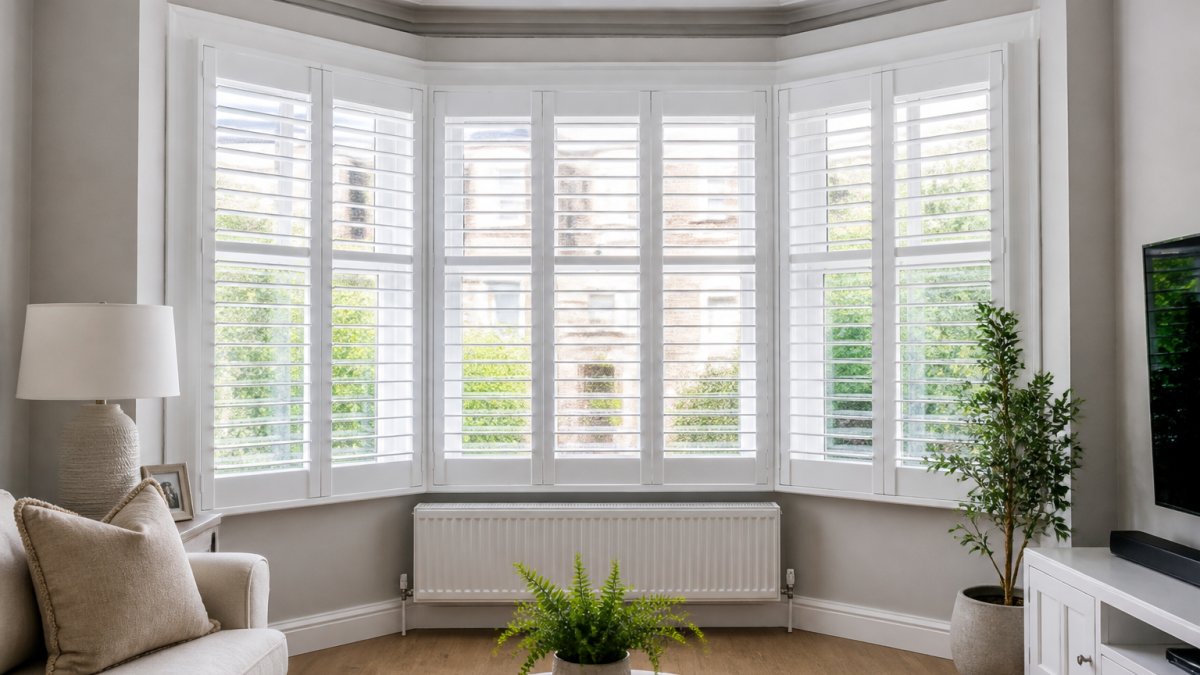
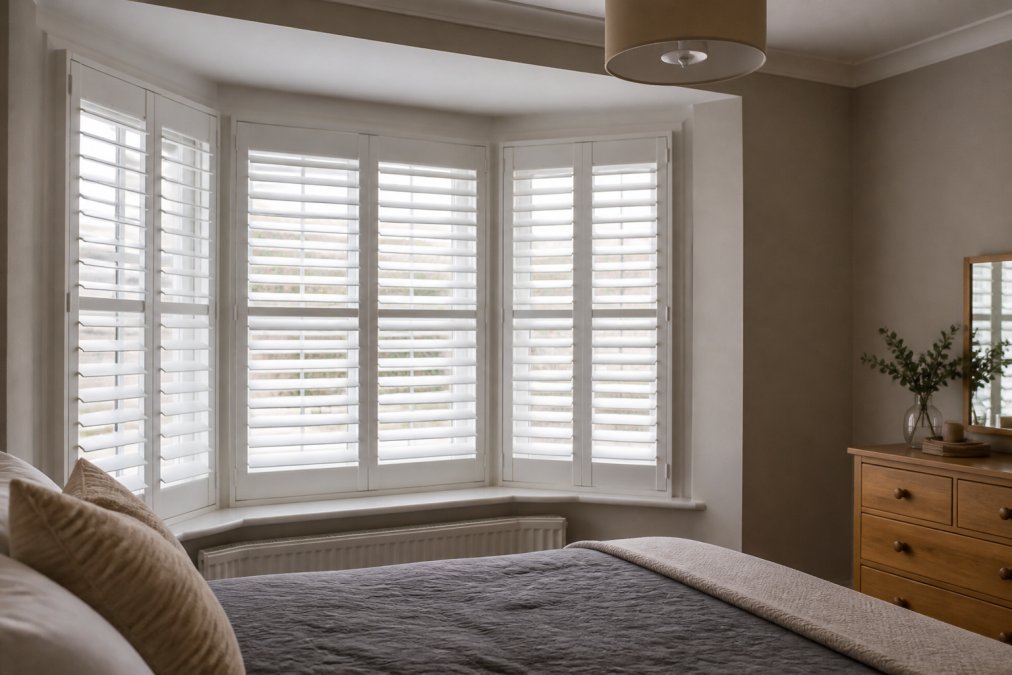
Bespoke plantation shutters are the only solution that solves the bay shape completely, because each panel is made for its own frame. There's no track to bend, no bracket to improvise, and no gap at the returns.
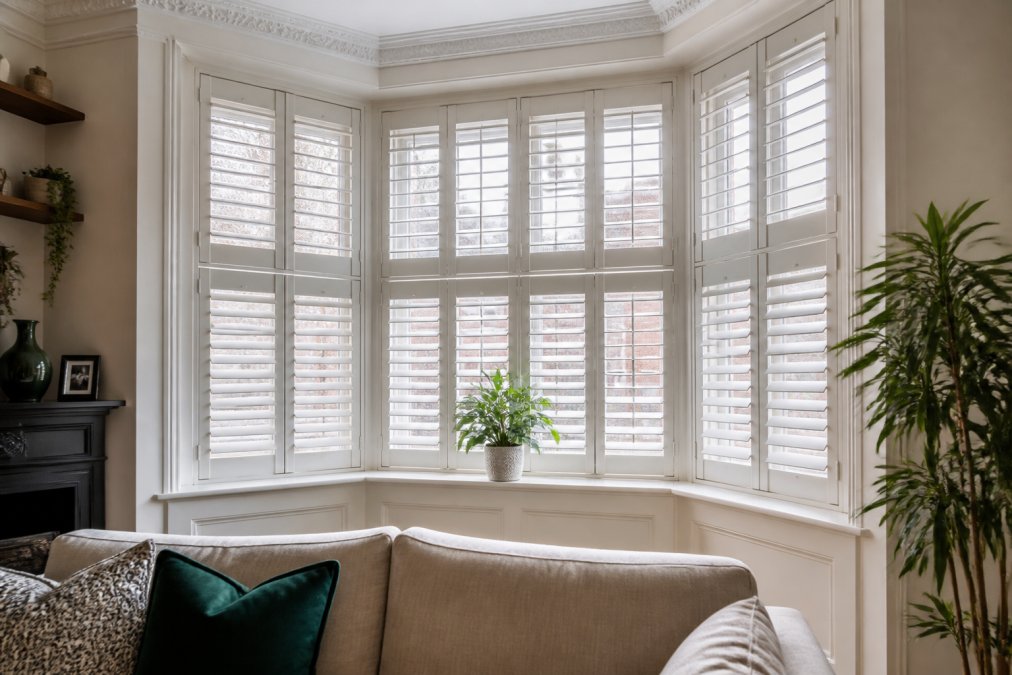
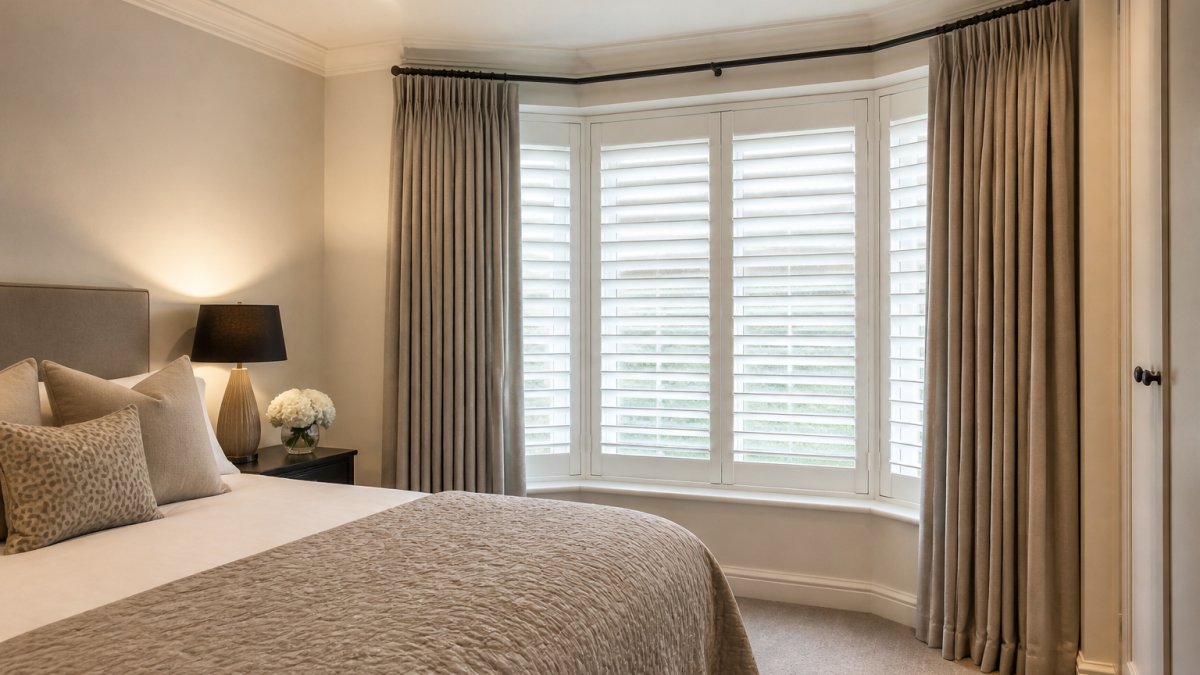
At Shutters West London, every set is made from scratch to the measurements of your window, including bay, arched and awkward frames. That's the difference between a shutter that fits and one that nearly fits. Slats tilt independently, so you can open the top section for daylight and close the bottom for privacy on the street side. Optional blackout features handle bedrooms.
How to Measure Bay Windows for Shutters (and Why It Matters)
Measuring a bay for shutters is not the same as measuring a flat window. You are measuring each section separately, and the angles mean a single width figure is useless.
Work through it in this order:
- Measure the width at the top, middle and bottom of each pane, and record the narrowest figure
- Measure the height at both the left and right side of each pane
- Measure the depth from the glass to the front of the frame or reveal
- Note the angle of each return, since panels are set out to follow it
- Check for obstructions: radiators, sills, handles, and anything that protrudes
The narrowest width and the shortest height are the figures that matter, because a shutter frame has to sit inside the smallest opening. Get this wrong and the panels will bind. This is also why a free home consultation and measurement is worth taking: a fitter will spot the out-of-square reveal or the sloping sill that a tape measure alone won't tell you.
Tier-on-Tier Shutters vs Full Height: Which Gives Better Bay Window Privacy?
Tier-on-tier shutters give better privacy control on a bay, because the top and bottom sections operate independently. Full height shutters are a single panel from top to bottom, which is simpler and often cheaper.
| Option | How it works | Best for | Trade-off |
|---|---|---|---|
| Tier-on-tier | Separate top and bottom panels, each with its own slats | Street-facing bays, rooms used day and night | More panels, more cost |
| Full height | One panel per section, slats throughout | Bays with no overlooking issue | Less flexible light control |
| Café style | Lower half only | Bays where you want the top clear | No privacy above the rail |
For a ground-floor bay onto a pavement, tier-on-tier is the better answer. You close the bottom tier in the evening and leave the top open for daylight. Full height works well upstairs, where the street can't see in anyway. Neither is universally better; it depends on what's actually looking in.
Common Mistakes to Avoid When Improving Bay Window Privacy
The recurring mistakes when working out how to make a bay window more private are predictable, and most of them cost money to undo.
- Treating the bay as one window. It's three or more windows at different angles, and each needs its own covering.
- Buying before measuring. Off-the-shelf sizes assume square openings. Bays rarely are.
- Ignoring the returns. The angled side panes are the ones people see from the street, and they're the ones most often left bare.
- Forgetting the night problem. Sheer coverings look private in daylight and transparent after dark.
- Choosing on price alone. A cheaper shutter that binds within two years is not cheaper.
If you want the job done once, with panels cut to your actual frames rather than a standard size, the British Blind and Shutter Association publishes guidance on what to check before commissioning window dressings. Shutters West London offers a free home consultation and measurements, with no-pressure quotes and a 10/10 Checkatrade rating across all reviews.
Frequently Asked Questions
Can you put shutters on a bay window?
Yes. Bay windows are one of the most common reasons homeowners choose made-to-measure shutters, because the angled side panels and wide central span need frames cut to the exact shape of the recess. A specialist will measure each panel separately, including the angles, so the shutters sit flush without gaps. Bespoke plantation shutters for bay windows are built from scratch rather than cut down from a standard size, which is why they handle Victorian and Edwardian bays so well.
How do you dress a bay window for privacy without losing light?
The trick is to control the lower half of the window and leave the top clear. Tier-on-tier shutters let you close the bottom panels for street-level privacy while keeping the upper panels open for daylight. If you prefer fabric, a voile panel across the lower section or a privacy film on the lowest panes achieves a similar effect. Frosted film on just the bottom row of glass is the cheapest option and takes under an hour to apply.
How do you measure a bay window for shutters?
Measure each section of the bay separately: the left return, the centre, and the right return. Take the width at the top, middle and bottom of each opening, and use the smallest figure. Measure the drop from the top of the recess to the sill at both ends of each section. For angled bays, you also need the angle of each corner. Because small errors show up as gaps or sticking panels, most homeowners have a specialist measure on site rather than relying on their own tape measure.
Are tier-on-tier shutters better than full height for a bay window?
It depends on how you use the room. Tier-on-tier shutters split into independent top and bottom panels, so you can shut the lower half for privacy and open the top for light. That suits living rooms and street-facing bedrooms. Full height shutters cover the whole window as one unit, which gives a cleaner, more uniform look and better insulation. If your bay faces a busy pavement, tier-on-tier usually wins on privacy; if you want an unbroken line across a wide bay, full height is often the better fit.
Bay windows are the hardest windows in the house to make private, and the quick fixes only get you so far. If you want the angles handled properly, with panels made for your frames rather than adjusted to fit them, Shutters West London brings 30 years of family-run craftsmanship to every set, made from scratch and never templated. Book a free home consultation and get a quote with no pressure attached.