 ultimate-guide
Interior Shutters: A Complete Buyer's Guide (2026)
Table of Contents
- What Interior Shutters Actually Are (and Why They're Different)
- Types of Interior Shutters: Styles and When to Use Each
- Full Height vs Tier-on-Tier Shutters: Which Suits Your Home?
- Shutters for Bay Windows: Fitting Complex Frames Properly
- Materials: Hardwood, MDF, and Faux Wood Compared
- Plantation Shutters Cost: What Affects the Price?
- Installation: DIY vs Professional Fitting
- Frequently Asked Questions
Last Updated: August 29, 2026
What Interior Shutters Actually Are (and Why They're Different)
Interior shutters are solid, hinged window coverings fitted directly to the window frame, not hung from a rail above it. Unlike blinds or curtains, shutters form part of the window architecture itself. They open, close, and tilt independently, giving you precise control over light and privacy without fabric that fades, frays, or collects dust.
At Shutters West London, we've spent 30 years fitting bespoke interior shutters across period properties and modern homes alike. Once fitted properly, a good set of interior shutters doesn't look like a window dressing, it looks like the window was always designed that way.
The key structural elements are straightforward: a frame fixed to the window reveal, hinged panels that fold back when open, and adjustable louvres (horizontal slats) that tilt to direct light. Some styles use solid panels entirely; others split the window into upper and lower sections for independent control.
Quality interior shutters depend on three things: material, fit, and finish. A shutter that doesn't sit flush to the frame, or one made from material that warps in a bathroom, will fail within years. According to the Which? guide on window dressings and home improvements, fit and material quality are the primary factors affecting longevity in window coverings, and with shutters, both are non-negotiable.
Types of Interior Shutters: Styles and When to Use Each
Not all interior shutters are the same. The style you choose affects how the room feels, how much light you control, and whether the shutter suits your window shape.
Solid Panel Shutters
Solid panel shutters have no louvres; the panels are completely flat and opaque. They're the oldest shutter style and most effective for rooms where you want total blackout or maximum insulation.
They work particularly well in bedrooms where sleep quality matters, and in rooms facing busy roads where both noise and light are problems. The trade-off is obvious: when closed, you have no light; when open, you have no privacy. There's no middle ground.
Plantation (Louvred) Shutters
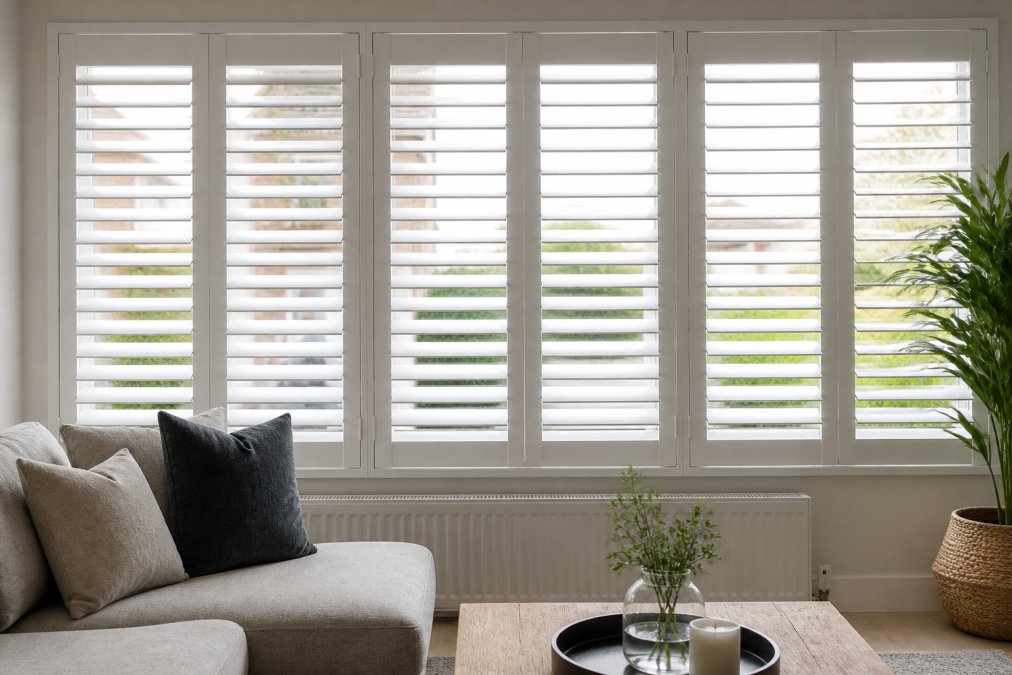
Plantation shutters are the style most people picture when they hear "interior shutters." Wide louvres, typically 63mm, 76mm, or 89mm, tilt to control both light and airflow without requiring the panels to open. This versatility makes them suitable for virtually every room: living rooms, kitchens, bathrooms, and hallways. They're also best suited to bay windows and unusual shapes, because each panel can be made to fit a specific section of the frame.
Café Style Shutters
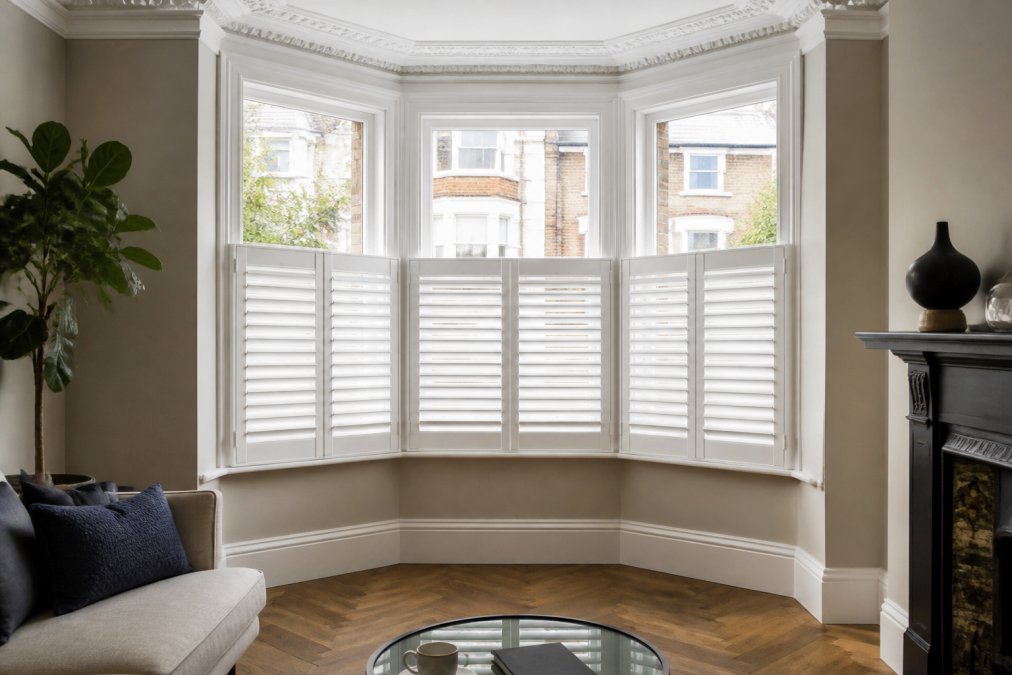
Café style shutters cover only the lower half of the window, leaving the upper half open to the sky. They solve a real problem for ground-floor rooms on busy streets: privacy at eye level without blocking daylight. The limitation is that they only work where the upper portion genuinely faces sky rather than a neighbour's window or wall.
Full Height vs Tier-on-Tier Shutters: Which Suits Your Home?
Full height shutters cover the entire window in a single set of panels. Tier-on-tier shutters split the window horizontally, with separate upper and lower panels that operate independently.
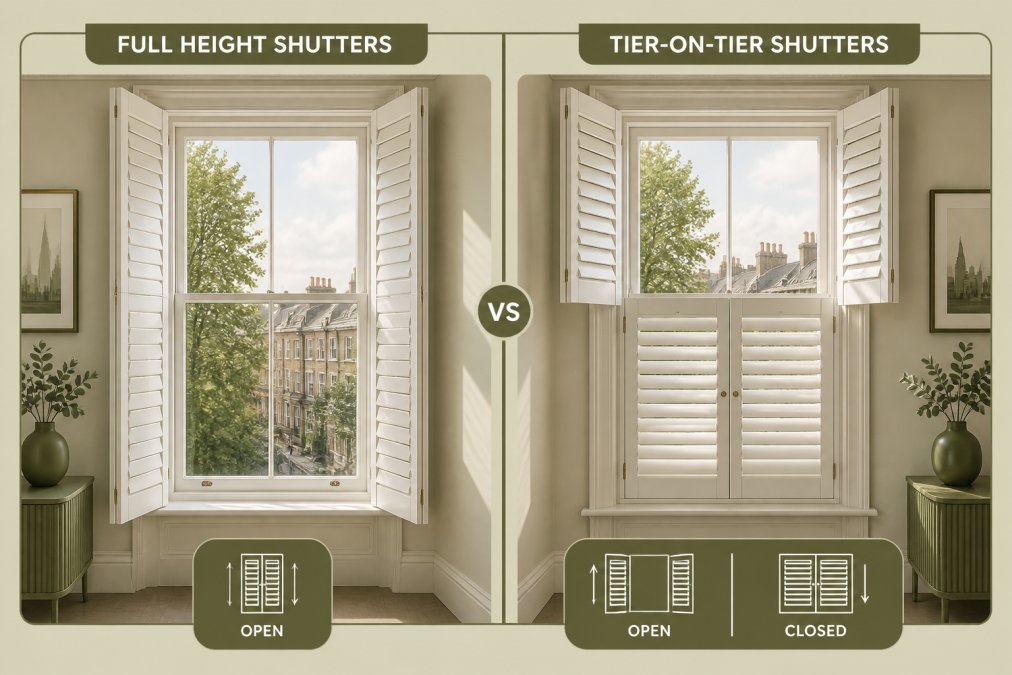
Full height shutters are the cleaner, simpler option. One set of panels, one tilt rod, one decision. They suit rooms where you want a consistent look and don't need to manage upper and lower light separately.
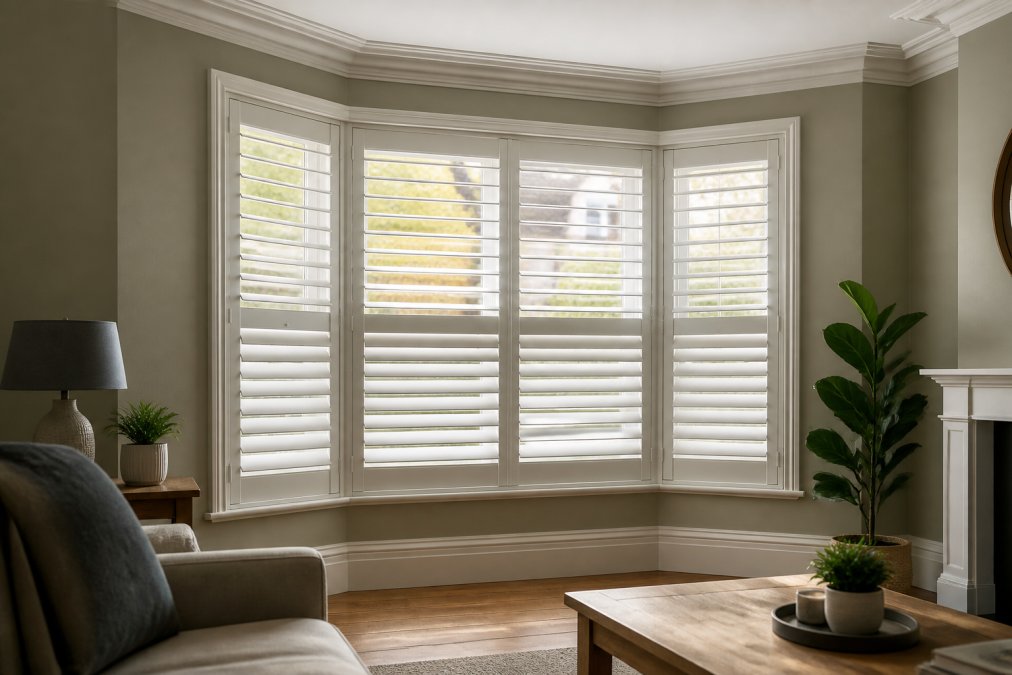
Tier-on-tier shutters are the right choice for sash windows in period properties. Sash windows have a natural horizontal divide at the meeting rail, and tier-on-tier shutters respect that architecture. You can open the top panels for daylight while keeping the lower panels closed for privacy from the street, something full height shutters cannot replicate.
| Configuration | Best For | Privacy Control | Light Control | Typical Windows |
|---|---|---|---|---|
| Full Height | Living rooms, kitchens, bedrooms | Good | Good | Casement, fixed |
| Tier-on-Tier | Period sash windows, street-facing rooms | Excellent | Excellent | Sash, tall windows |
| Café Style | Ground-floor street-facing rooms | Lower half only | Upper half open | Any style |
| Solid Panel | Bedrooms, media rooms | Total | Total (closed) | Any style |
Shutters for Bay Windows: Fitting Complex Frames Properly
Bay windows are where most shutter installations either succeed beautifully or fail expensively. The challenge is geometry: a bay window projects outward at an angle, creating angled sections that must each be measured and fitted independently.
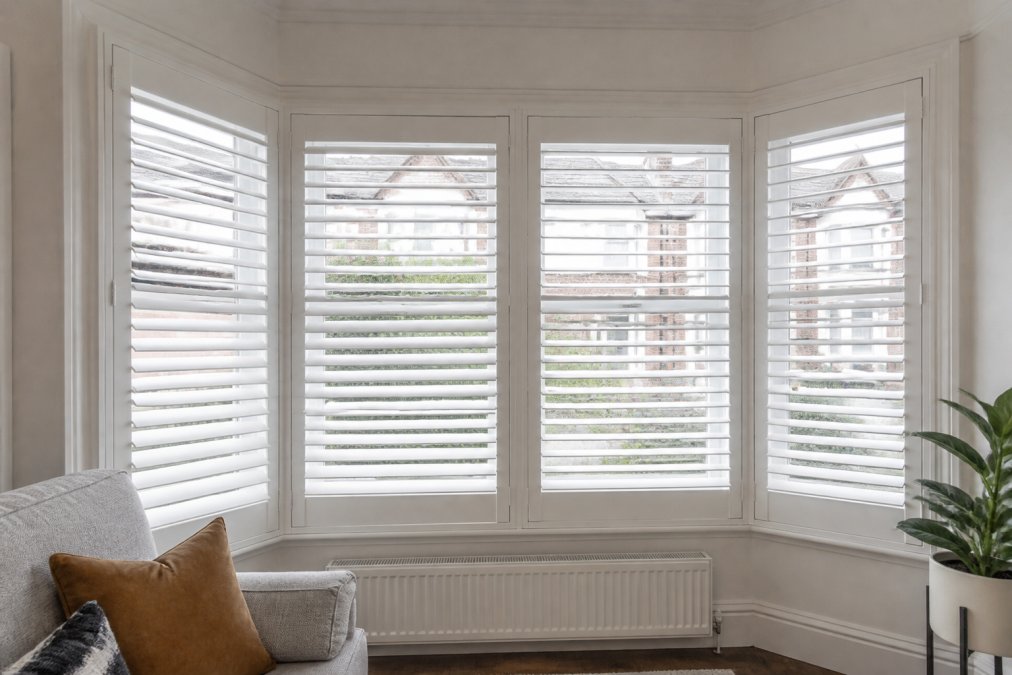
The most common mistake is treating the bay as a single window. A typical three-section bay has a central flat panel flanked by two angled returns. Each section needs its own frame, its own panels, and critically, its own angle cut where frames meet. Get that angle wrong by even a few degrees and you'll have visible gaps and panels that won't close flush.
This is the question we hear most often: "Will shutters work with my Victorian bay windows?" The honest answer is yes, but only if every measurement is taken on site, by hand, from the actual window. Template-based systems cannot account for variation in Victorian bay geometry. No two are identical.
According to Historic England's guidance on maintaining period properties, Victorian terraced houses often have non-standard window dimensions and irregular reveals due to pre-industrial construction methods. This is why made-to-measure is the only viable approach for shutters in period homes.
The frames for each bay section are typically mitred at the join point to create a continuous, clean line across the whole bay. When done properly, the result looks like the shutters were always part of the window.
Materials: Hardwood, MDF, and Faux Wood Compared
The material your interior shutters are made from determines how they age, where they can be fitted, and what they cost.
Hardwood is the benchmark. Real timber, typically basswood or paulownia, machines cleanly, holds paint well, and maintains its shape over decades when properly sealed. Hardwood shutters feel substantial when you operate them. The limitation is cost and sensitivity to extreme moisture. In a bathroom with poor ventilation, even hardwood can warp if not correctly sealed.
MDF (medium-density fibreboard) is cheaper and paints to a smooth finish. For dry rooms, living rooms, bedrooms, hallways, MDF shutters perform well. The problem is moisture. MDF absorbs water and swells. A bathroom, kitchen above the hob, or conservatory with condensation will destroy MDF shutters within years.
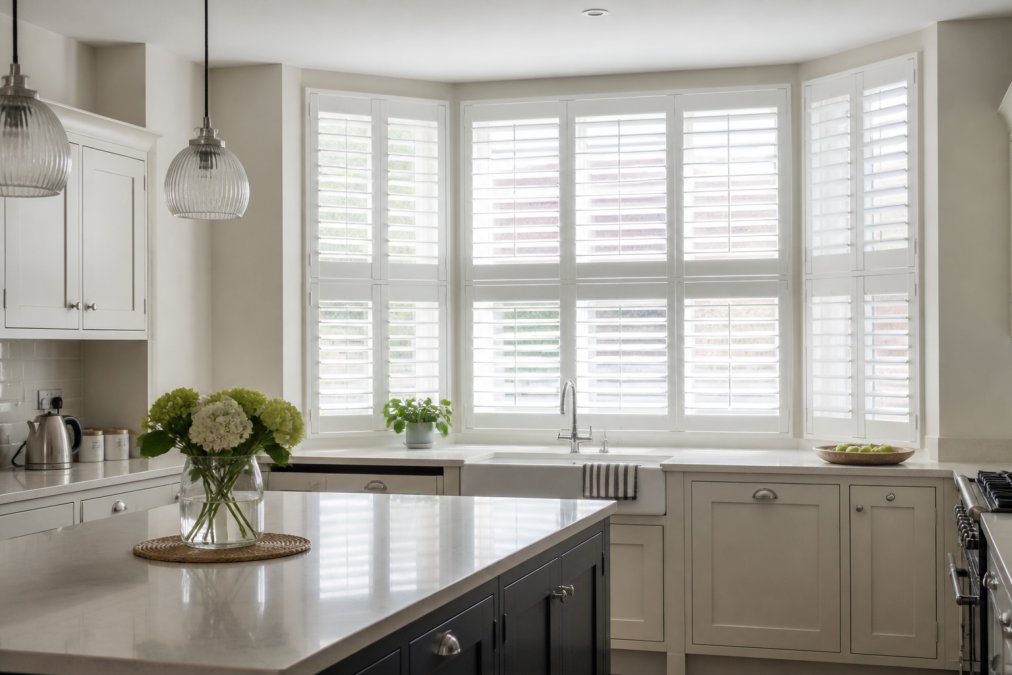
Faux wood (PVC or composite) is the correct answer for wet rooms. It doesn't warp, doesn't absorb moisture, and cleans easily. The trade-off is that it lacks the weight and feel of real timber, and most faux wood shutters come in limited white and off-white finishes.
The Building Research Establishment's guidance on moisture control in domestic properties is clear that sustained humidity above 70% will degrade most wood-based products over time, which is why material selection for bathroom shutters should prioritise moisture resistance.
Plantation Shutters Cost: What Affects the Price?
Plantation shutters cost more than blinds or curtains. The gap in price reflects a genuine gap in what you're getting.
The factors that drive cost upward are: window size, material choice, configuration complexity, and whether frames require special joinery for unusual shapes. A straightforward casement window costs less than a three-section Victorian bay with tier-on-tier shutters in hardwood.
What most homeowners don't account for is the cost-per-year calculation. Well-made hardwood interior shutters, properly fitted, should last 20 years or more with minimal maintenance. Cheap blinds typically need replacing every three to five years. Over two decades, the maths often favours the shutter.
Every set we make is built from scratch, measured on site, and fitted by experienced installers. There are no templates, no off-the-shelf panels cut down to size. That process costs more, but it means the shutters fit the window rather than the window accommodating the shutter.
For current pricing, a free home consultation with on-site measurements gives an accurate quote that online calculators cannot match. As the Federation of Master Builders' advice on getting accurate home improvement quotes notes, on-site assessment is the only reliable basis for a fixed-price quotation on bespoke joinery work.
Installation: DIY vs Professional Fitting
Interior shutters can technically be fitted by a competent DIYer, but the gap between "technically possible" and "actually advisable" is wider here than with most home improvements.
The frame must be perfectly level and square to the window reveal. If it isn't, the panels won't hang true, the louvres won't tilt evenly, and gaps around the frame will be visible. In a standard rectangular window with a clean, square reveal, an experienced DIYer with the right tools can achieve this. In a bay window, curved arch, or any reveal that isn't perfectly square, which describes most period properties, the margin for error is essentially zero.
Professional fitting also matters for the warranty. Most quality shutter manufacturers will not honour a guarantee on self-installed shutters, because incorrect fitting is the most common cause of early failure. Sticking panels, grinding louvres, and frames that pull away from the wall are almost always installation problems, not manufacturing defects.
The fitting itself takes less time than the preparation. Getting the reveal truly square, shimming the frame correctly, and ensuring hinges are aligned, that's where the hours go. A professional installer has done it hundreds of times and carries the tools to do it accurately. For a standard window, professional fitting typically takes two to four hours. For a bay window, allow a full day.
If you're committed to DIY, restrict it to simple casement windows with clean, square reveals. For anything more complex, the cost of professional fitting is considerably less than the cost of having shutters removed, adjusted, and refitted.
Choosing the right interior shutters involves more decisions than most homeowners expect, from style and material to configuration and fitting method. The Shutters West London team offers a free home consultation that covers every one of those decisions without any pressure to commit. With a 10/10 Checkatrade rating across all reviews and 30 years of family-run craftsmanship, every set is made from scratch to fit your specific windows. Get a free quote and see what made-to-measure interior shutters can do for your home.
Frequently Asked Questions
Are interior shutters worth the investment for my property?
For most homeowners, interior shutters are a long-term investment rather than a short-term purchase. Unlike curtains or blinds, well-made shutters are fixed to the frame and built to last decades with minimal maintenance. They improve light control, privacy, and insulation, and many estate agents note that fitted shutters can add to a property's perceived value and kerb appeal. The key is choosing made-to-measure shutters over off-the-shelf alternatives, which rarely fit correctly and wear out faster.
Can interior shutters be fitted to bay or arched windows?
Yes, but only if they are made to measure for those specific frames. Standard shutters will not sit flush against the angles of a bay window or follow the curve of an arch. A specialist who takes precise on-site measurements and builds each panel from scratch can produce shutters that fit any shape cleanly. This is one of the main reasons bespoke interior shutters cost more than mass-produced options, the additional complexity in both measurement and construction is significant.
What is the difference between plantation shutters and standard interior shutters?
Plantation shutters have wide, adjustable horizontal louvres, typically 63 mm to 89 mm across, that you tilt to control light and airflow without opening the panel itself. Standard interior shutters often use solid panels or much narrower fixed slats. Plantation shutters became popular in the UK because the louvre design suits both period and contemporary homes, and they give far more precise control over light direction than solid or café-style alternatives.
How do I clean and maintain my interior shutters?
Most interior shutters only need a light dust with a dry or slightly damp cloth every few weeks. For louvred shutters, running a microfibre cloth along each slat takes a few minutes per window. Avoid saturating wood shutters with water, as prolonged moisture can cause warping over time. Faux wood and MDF shutters tolerate slightly more moisture, making them a practical choice for kitchens and bathrooms. Hinges and tilt rods rarely need attention, but a small amount of light oil once a year keeps them moving smoothly.
This article was written using GrandRanker