 how-to
Why Plantation Shutters Grind and Stick: 2026 Fix Guide
Table of Contents
- Why Plantation Shutters Grind and Stick: The Common Causes
- How to Adjust Plantation Shutter Hinges to Stop Grinding
- Shutter Louvre Tension Adjustment: A Step-by-Step Fix
- What You'll Need Before You Start
- Plantation Shutter Maintenance Tips That Prevent Sticking
- Common Mistakes to Avoid When Fixing Sticking Shutters
- When to Call a Professional Shutter Specialist
- Frequently Asked Questions
Last Updated: September 12, 2026
Why Plantation Shutters Grind and Stick: The Common Causes
Plantation shutters grind and stick when the panel rubs against the frame, when hinges lose alignment, or when timber moves with changes in humidity and heat. The noise is rarely a sign that the shutters are failing. It is a sign that something has shifted by a millimetre or two.
At Shutters West London, we have fitted bespoke shutters into period properties for three decades, and the same handful of causes come up again and again. Most are fixable in under an hour with a screwdriver and a little patience. Below, we break down each cause, then walk through the exact adjustments that stop the grind for good.
Two forces do almost all the damage: the frame moving, and the timber moving. Understanding which one you are dealing with tells you whether to reach for a screwdriver or a dehumidifier.
Frame Rub and Settlement in Older Properties
Older properties rarely have square window reveals. Victorian and Edwardian homes have had decades of settlement, and bay windows in particular can shift out of true by several millimetres over time (historicengland.org.uk). When a frame settles, the opening narrows slightly, and a panel that once cleared the frame with room to spare begins to rub against it.
A common mistake is to assume the shutter itself has warped. In practice, the frame has usually moved, not the panel. Check the gap between the panel edge and the frame at the top, middle, and bottom. If the gap narrows toward one corner, settlement is the likely culprit. This is where made-to-measure shutters fitted to the actual opening, rather than a standard template, make a real difference: a panel cut to a settled frame has far less room to shift before it starts to bind.
Humidity, Heat and Timber Movement
Timber is not inert. It absorbs moisture from the air and releases it again, swelling in damp conditions and shrinking when the heating is on. A shutter panel that fits perfectly in a mild September can bind by January once central heating dries the air and the frame contracts around it.
The Wood Protection Association guidance on timber and moisture explains how moisture content drives movement in joinery, and the same principle applies to interior shutters. Rooms that swing between humid and dry, such as bathrooms and kitchens, see the most movement. The fix is rarely to sand the panel down. It is to manage the room's humidity and to keep the hinges correctly tensioned so the panel can move without grinding.
How to Adjust Plantation Shutter Hinges to Stop Grinding
Adjusting plantation shutter hinges is the first fix to try, because a hinge that has dropped or loosened is the most common cause of a grinding panel. The job takes around 15 minutes per panel.
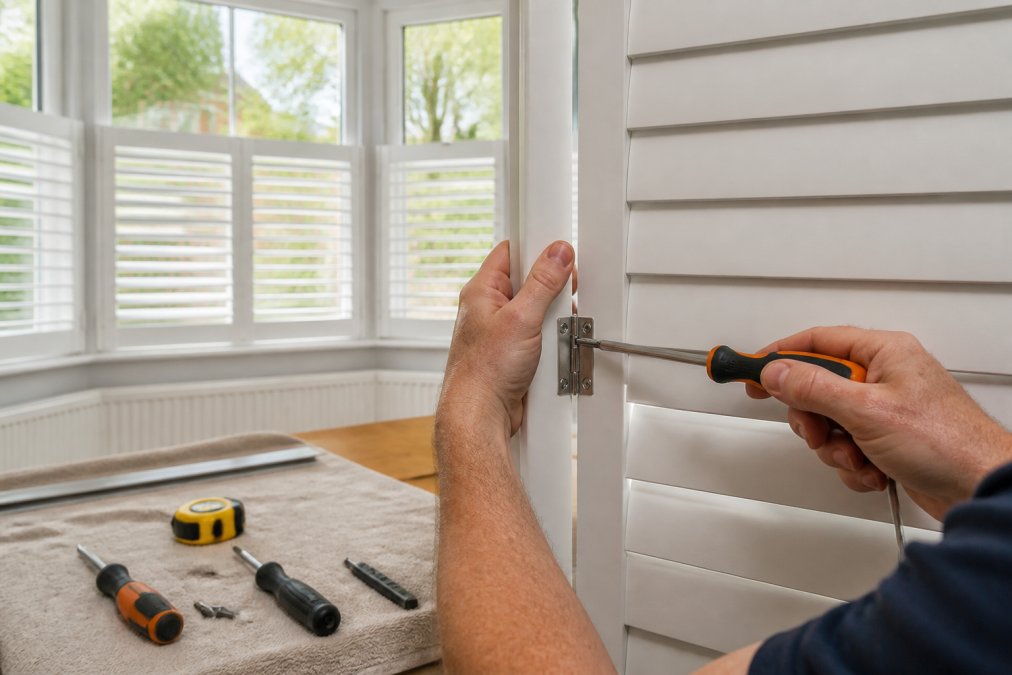
Work through these steps:
- Open the panel fully and support its weight with one hand. Panels are heavier than they look.
- Inspect the hinge screws. Loose screws let the panel drop, so the bottom edge catches the frame.
- Tighten each screw a quarter turn at a time. Do not over-tighten into old timber, or the screw will strip its hole.
- If a screw spins freely, the hole has worn. Remove the screw, insert a wooden matchstick or a sliver of hardwood into the hole, and re-drive the screw.
- Check the panel swing again. If it still grinds, loosen the hinge screws slightly and lift the panel a millimetre before re-tightening.
Shutter Louvre Tension Adjustment: A Step-by-Step Fix
Shutter louvre tension adjustment controls how firmly the slats hold their position, and it is a separate job from hinge alignment. If your louvres droop, feel loose, or the tilt rod grinds when you rotate them, the tension screw needs attention.
Most plantation shutters hide a small tension screw at the end of each louvre, set into the side stile. The process is straightforward:
- Close the louvres to a horizontal position so you can see the full run.
- Locate the tension screw at the end of the louvre, usually on the hinge-side stile.
- Turn the screw clockwise in small increments, an eighth of a turn at a time.
- Test the louvre after each adjustment. It should hold position under its own weight without feeling stiff.
- Repeat along the panel until every louvre moves smoothly and stays put.
The British Standards Institution guidance on building hardware sets out how hardware components should perform under repeated use, which is a useful benchmark: if a louvre needs constant re-tensioning, the mechanism may be worn rather than simply loose.
What You'll Need Before You Start
Gather these tools before you touch the shutters, so you are not leaving a panel hanging while you search for a screwdriver:
- A small flat-head and a Phillips screwdriver that fit the hinge and tension screws exactly
- A wooden matchstick or hardwood sliver for worn screw holes
- A soft cloth and a mild soap solution for cleaning around the hinges
- A spirit level to check whether the panel is sitting square in the frame
- A hygrometer, inexpensive and useful, to monitor the room's humidity
Plantation Shutter Maintenance Tips That Prevent Sticking
Regular maintenance prevents most grinding before it starts. A few minutes every few months keeps panels swinging freely and louvres holding their position.
Dust the louvres and stiles with a microfibre cloth every couple of weeks. Twice a year, check and tighten every hinge screw, and apply a single drop of light machine oil to each hinge pin. Keep interior humidity steady where you can; a room that swings from damp to bone-dry will move timber more than a stable one.
Common Mistakes to Avoid When Fixing Sticking Shutters
Sanding the panel is the mistake we see most often. When a panel grinds, the instinct is to remove material from the edge. Do this and you fix the symptom while the real cause, a dropped hinge or a settled frame, gets worse. You also remove the factory finish from the panel edge, leaving bare timber that will absorb moisture and swell.
The second common error is over-tightening hinge screws into old timber. Period frames have seasoned, sometimes brittle wood, and a screw driven too hard strips the hole and leaves the hinge looser than before. The third is ignoring humidity. If a room is consistently damp, no amount of adjustment will stop the timber moving.
When to Call a Professional Shutter Specialist
Some problems are beyond a home adjustment. Call a specialist if the frame itself has moved out of square, if a panel has warped, or if hinges are worn to the point where they no longer hold. These need the panel re-hung or the frame re-set, and forcing a fix risks damaging the shutters.
At Shutters West London, every set is made from scratch and fitted to the actual opening, which is why our panels have far less room to shift than templated alternatives. Our 10/10 Checkatrade rating across all reviews reflects three decades of family-run craftsmanship, and our free home consultation includes measurements and honest advice on whether an adjustment or a replacement is the right call.
A grinding shutter is usually telling you something simple: a hinge has dropped, a louvre has loosened, or the timber has moved with the seasons. Most of these you can fix yourself in an afternoon, but when a frame has settled out of square, professional attention saves you from making it worse. Shutters West London offers free home consultations, 100% made-to-measure panels, and expertise with bay, arched, and awkward window shapes. Get started with Shutters West London and keep your shutters swinging smoothly for years.
Frequently Asked Questions
Why do my plantation shutters rub against the frame?
Shutters rub against the frame when the panel has shifted on its hinges, the timber has expanded with humidity, or the frame itself has moved as the building settles. Period properties with bay or arched windows are especially prone to this. Loosening the hinge screws slightly and repositioning the panel often clears the rub. If the frame has warped, a specialist can assess whether the panel needs re-hanging or the frame needs adjustment.
Can humidity cause plantation shutters to stick?
Yes. Timber absorbs moisture from the air, so in damp conditions panels and louvres swell slightly. That extra millimetre is often enough to make a louvre catch on the frame or a panel drag on the hinge. Kitchens, bathrooms and rooms with poor ventilation are the usual culprits. Keeping indoor humidity stable and wiping shutters dry after cleaning reduces how often this happens.
Should I lubricate my plantation shutter hinges?
A small amount of dry silicone lubricant or a graphite pencil rubbed on the hinge pin can quiet a squeaky hinge without attracting dust. Avoid oil-based products, which collect grit and turn into a sticky paste that makes grinding worse over time. If a hinge still grinds after cleaning and light lubrication, the hinge itself may be worn and worth replacing rather than repeatedly treating.
How do I stop my shutters from sticking again after I fix them?
Check hinge screws every few months and tighten any that have worked loose. Keep louvres at a consistent tension rather than forcing them, and dust the tilt rod and louvre pins regularly. In older properties, allow for seasonal timber movement instead of adjusting panels too tightly. A short maintenance routine is far easier than fixing a seized mechanism later.