 how-to
How to Choose Window Shutters for Art Deco Homes
Last Updated: November 1, 2026
Quick Summary
To learn how to choose window shutters for art deco homes, start with the frame rather than the fabric: match the room's geometry, keep panels symmetrical and favour simplified lines over fussy detailing. Made-to-measure panels suit angled bays and curved arches, and full-height shutters preserve the tall proportions of the period.
- Angled bay returns need panels cut to the exact degree of the reveal, not a standard template.
- A curved shutter must match the frame's radius exactly or gaps will show at the edges.
- Full-height shutters preserve tall Art Deco proportions; café-style suits kitchens and bathrooms.
- Mid louvres of around 64mm are the versatile choice for most Art Deco rooms.
- Wood takes a painted finish cleanly; composite is the practical option in damp rooms.
Table of Contents
- Start With the Art Deco Rules: Geometry, Symmetry and Simplified Lines
- Shutters for Bay Windows: Handling Angles and Returns
- Shutters for Arched Windows: Curved Frames Done Properly
- Full-Height vs Café-Style Shutters: Which Suits an Art Deco Room
- Shutter Louvre Sizes and Light Control: Getting the Slats Right
- Materials, Colours and Finishes That Stay Period-Appropriate
- Book a Free Home Consultation and Measurement
- Frequently Asked Questions
Start With the Art Deco Rules: Geometry, Symmetry and Simplified Lines
Art Deco is a design language built on geometry, symmetry and simplified lines. Get those three right and the rest of your choices fall into place. Get them wrong and even expensive shutters will look out of place.
At Shutters West London, we make made-to-measure shutters for period homes. Your window shutters should echo that, not fight it.
So how to choose window shutters for art deco homes without turning the room into a pastiche? Start with the frame, not the fabric.
- Geometry first: look at the shapes already in the room. Sunbursts, chevrons, stepped corners and clean rectangles all point to a particular louvre and panel layout.
- Symmetry second: Paired panels and even splits help keep an Art Deco room balanced.
- Simplified lines third: avoid fussy detailing. Simple, clean shutter styles suit the period far better than ornate ones.
In an Art Deco home, shutters are best treated as part of the architecture. Below, we break down how to choose window shutters for art deco homes window by window, from bay frames to arches.
Shutters for Bay Windows: Handling Angles and Returns
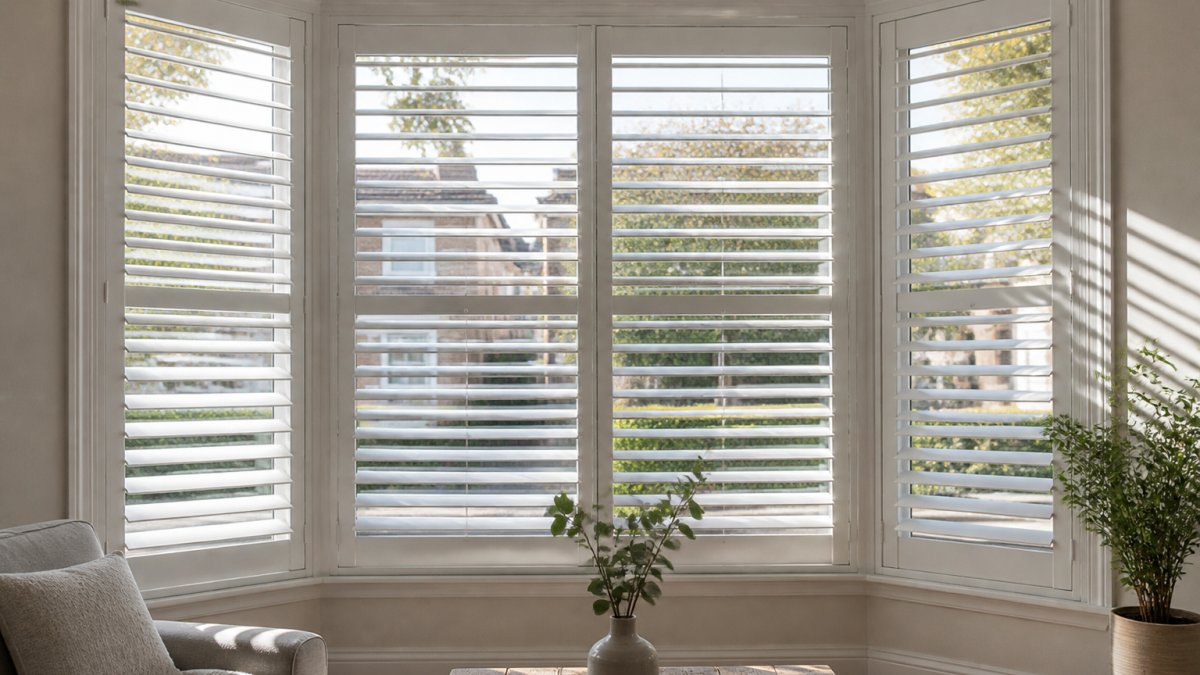
Bay windows are the defining feature of many Art Deco front rooms, and they are also where cheap shutters fall apart. Angled returns need panels cut to the exact degree of the reveal, not a standard template.
A common mistake is ordering shutters sized for the flat front only. The angled side panels then sit proud or gap at the edges, and the whole bay looks wrong. Made-to-measure shutters address this because each panel is made to the actual angle.
For a deep bay, full-height panels across the front keep the simplified look, and consistent louvre size across every panel helps the lines read as one continuous run.
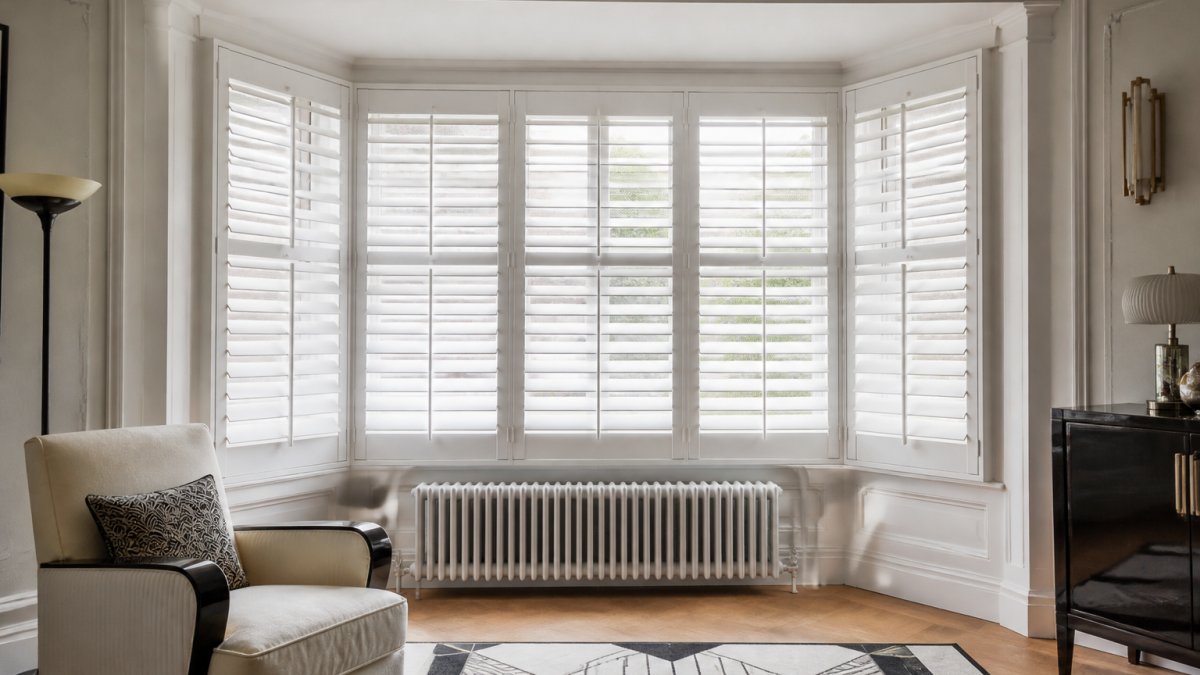
If your bay has unusual angles, the first step is getting the measurements right. Our guide on how to measure bay windows for shutters walks through the method before you plan anything else.
Shutters for Arched Windows: Curved Frames Done Properly
Arched windows are where Art Deco homes often show off, and they are the hardest windows to dress well. A curved frame needs a curved shutter, and that means bespoke construction rather than an off-the-shelf panel forced into the opening.
Curved frames can be dressed with a single panel that follows the arch, or with a shaped top section and operable shutters below.
What most guides miss is that the curve has to match the frame's radius exactly. A panel that is close but not exact will show a gap at the edges, and on a pale wall that gap is the first thing you notice.
An arched window owner should measure carefully before ordering. Our step-by-step guide to measuring arched windows covers curved frames in detail.
Full-Height vs Café-Style Shutters: Which Suits an Art Deco Room
Full-height shutters cover the whole window, floor to head, while café-style shutters cover only the lower half. Full-height shutters preserve the tall, simplified proportions the period is known for.
Here is how the two compare:
| Style | Best for | Trade-off |
|---|---|---|
| Full-height | Tall Art Deco windows, formal rooms | Higher material cost |
| Café-style | Kitchens, bathrooms, street-facing lower windows | Leaves the top half open |
| Tier-on-tier | Rooms needing flexible light control | More panels to operate |
Café-style shutters suit a kitchen or a room where you want privacy at eye level but plenty of natural light above. They can look slightly out of step in a formal front room with tall windows, though. Full-height panels keep the vertical lines clean and uninterrupted.
Shutter Louvre Sizes and Light Control: Getting the Slats Right
Louvre size decides how much light you let in and how the shutters look. Smaller louvres give a finer, more detailed appearance. Larger louvres let in more light when open and read as bolder, cleaner lines.
A mid-range louvre is a versatile choice for many Art Deco rooms, balancing the geometric feel of the period with practical light control. Louvre size can be chosen by window size and the amount of light wanted:
- Small louvres (around 47mm): best for small windows and a traditional look
- Mid louvres (around 64mm): the versatile choice for most rooms
- Large louvres (around 89mm): good for big windows and maximum light
Tilt rods matter too. A central tilt rod keeps the panel symmetrical, which suits the Art Deco eye. Offset rods leave the face cleaner. Either way, the goal is even, controllable light with lines that stay straight when closed. For a direct comparison, see our guide to plantation shutters vs blinds for light control.
Materials, Colours and Finishes That Stay Period-Appropriate
Material and finish choices make or break the period look. Wood suits Art Deco homes best because it takes a painted finish cleanly and feels right against original joinery. Composite is the practical alternative in damp rooms such as bathrooms, where solid timber can move with steam and heat.
On colour, restraint wins, but restraint does not mean bland. Art Deco interiors were rarely monochrome. The period palette was built on contrast: a pale ground with a deliberate accent, often in black, deep green, burgundy or metallic. Your shutters should sit within that logic rather than introduce a new one.
A workable approach is to decide the shutter colour by the role the window plays in the room:
- Background windows, the majority in a room, should recede. Off-whites, creams and soft greys keep the geometric lines of the shutters legible without competing with original fireplaces, cornices or light fittings.
- Feature windows, a bay, an arched window or a pair flanking a chimney breast, can carry a deliberate accent. Charcoal, muted green or a deep blue-grey reads as period-appropriate when the room already has a darker anchor, such as a black mantel or dark timber floor.
- Small rooms and corridors benefit from lighter shutters because they reflect light back into the space and stop the panels reading as heavy blocks.
Finish matters as much as colour. Gloss or satin finishes catch the light and echo the polished surfaces Art Deco interiors often used, lacquered cabinets, chrome trim, mirrored panels. A dead-flat matt can look a little plain by comparison, particularly on full-height panels where a slight sheen helps the louvres read as a single surface when closed. Eggshell sits between the two and is a common choice where a softer look is wanted without losing definition.
The thing nobody tells you about authenticity is that modern performance does not have to be sacrificed. For the full picture on materials, styles and options, read our complete interior shutters buyer's guide. Made-to-measure shutters can offer privacy and light control while still looking period-correct. The trade-off is usually in the detail rather than the principle: a slim louvre and a simple frame profile will look more authentic than a chunky panel with decorative moulding, even if both are painted the same colour.
Book a Free Home Consultation and Measurement
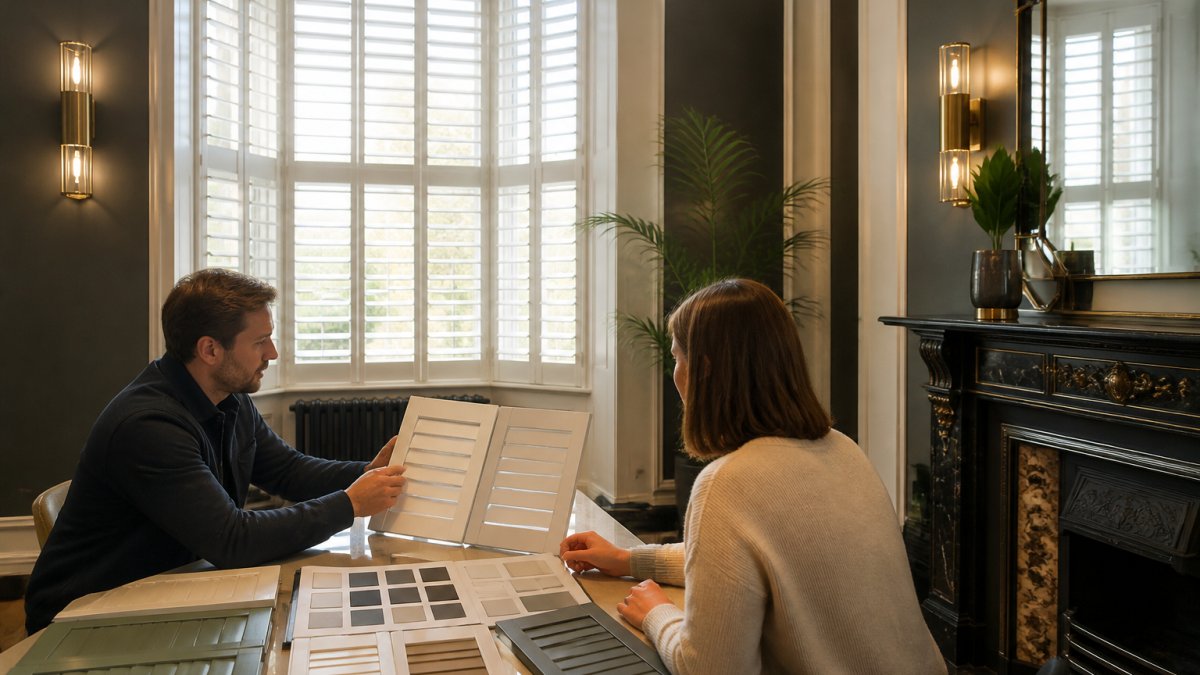
Before any consultation, it helps to understand what the measurement visit involves. Art Deco homes rarely have standard openings. Reveals are often deeper than modern equivalents, original trim may be uneven, and bay or arched frames can be out of square by a few millimetres that matter when a panel is cut to fit.
If your property is listed or sits within a conservation area, check before you order. Listed building consent may be required for alterations that affect the character of a listed building, and conservation area rules can restrict some changes. Check with your local planning authority. Interior shutters are often more straightforward than exterior ones, but the safe approach is to confirm with your local planning authority before committing to a specification. The same applies if your home is in a flat within a converted period building, where the freeholder or management company may have its own rules about window fittings.
Accurate measurement in your own home is a key step. Our bespoke shutter installation timeline explains what the full process involves. A free home consultation and measurements are offered.
At Shutters West London, we bring 30 years of family-run craftsmanship to every job. Every set is made from scratch and 100% made-to-measure, never templated. We specialise in bay, arched and awkward window shapes.
You get complete personalisation of styles, colours and tilt rods, plus optional blackout for full light control. Pricing depends on window count, size and specification, and we offer fair, honest, no-pressure quotes. We hold a 10/10 Checkatrade rating across all reviews.
Get started with Shutters West London and give your Art Deco windows the fit they deserve.
Frequently Asked Questions
What style of shutters suits an Art Deco home?
Art Deco design favours clean geometry, symmetry and streamlined lines, so full-height louvred shutters with a simple frame suit it best. Avoid ornate mouldings or fussy architraves, which fight the period's look. Tier-on-tier configurations work well on tall windows because the horizontal divisions echo the stepped, geometric motifs of the era. Keep the panel layout symmetrical across the window, and choose a finish that either matches the original joinery or sits quietly against the wall colour.
Are plantation shutters suitable for Art Deco windows?
Yes. Plantation shutters are simply louvred shutters with wide slats in a solid frame, and their plain rectangular panels fit Art Deco interiors well. The key is the detail: specify a square, unadorned frame and avoid decorative pelmets or carved trims. For curved or arched openings, the panels need to be made to measure rather than cut from a standard template, because the frame has to follow the curve precisely. A home measurement will confirm what your particular window shapes allow.
What colour shutters work best in an Art Deco interior?
Period-appropriate choices are soft whites, off-whites, warm creams and deep tones such as charcoal or muted green. White and cream keep a room light and let geometric wallpaper or tiled fireplaces lead. Darker finishes suit studies and bedrooms where you want a bolder, more tailored look. Matching the shutter colour to the existing window frame keeps the architecture reading as one piece, while matching the wall colour makes the shutters recede.
Should I choose full-height or café-style shutters for an Art Deco home?
Full-height shutters usually suit Art Deco rooms better because the uninterrupted vertical lines reinforce the period's streamlined look. Café-style shutters cover only the lower half of the window, which can work in a kitchen or bathroom where you want light above and privacy below, but the horizontal break can interrupt a tall, symmetrical façade.
Choosing window shutters for an Art Deco home comes down to respecting the geometry, matching the frame and getting the finish right. It is detailed work, and the details are where most off-the-shelf options fall short. Get a free quote from Shutters West London and we will measure every window, talk through the styles and colours that suit your period, and build each set to fit.