 ultimate-guide
7 Reasons Plantation Shutters Suit Scandi Design
Last Updated: 3 November 2026
Quick Summary
Plantation shutters suit Scandi design because their flat frames and slim louvres give clean lines without heavy fabric, and tilting the louvres lets you direct daylight rather than simply block it. That mix of function and restraint fits Nordic style, which is why plantation shutters have become a default choice in pared-back British homes.
- Tilting the louvres bounces daylight off the ceiling or pushes it deep into a room while cutting harsh glare.
- Soft whites, chalky off-whites and pale greys are the best shutter colours for minimalist homes.
- Match the shutter to the lightest tone in the room rather than the darkest to keep the window wall receding.
- Full height shutters give the cleanest line, while tier-on-tier wins on practicality in street-facing rooms and bays.
- A closed shutter softens traffic hum but is not a substitute for secondary glazing where noise is severe.
Table of Contents
- Why Plantation Shutters Fit Scandi Design So Well
- The Benefits of Plantation Shutters for Light Control
- Clean Lines, Organic Textures and the Minimalist Aesthetic
- The Best Shutter Colours for Minimalist Homes
- Full Height or Tier-on-Tier: Choosing the Right Style
- Bespoke Shutter Installation for Period Properties
- Acoustics, Energy Efficiency and Smart Home Integration
- Book a Free Home Consultation and Measurement
- Frequently Asked Questions
Why Plantation Shutters Fit Scandi Design So Well
Scandinavian design is built on a simple bargain: let in as much daylight as possible, keep everything else quiet. Plantation shutters are one of the few window treatments that deliver on both counts, which is why they suit minimalist interiors. Their flat frames and slim louvres give you clean lines without heavy fabric, and you can adjust light direction rather than simply blocking it. That combination of function and restraint sits at the heart of Nordic style, and it explains why plantation shutters have become a default choice in pared-back British homes.
The logic is straightforward once you see it. Scandi rooms rely on pale walls, natural materials and uncluttered surfaces, so anything fixed to the window has to earn its place. Shutters do, because they can control glare, filter light softly and add little visual weight.
The Benefits of Plantation Shutters for Light Control
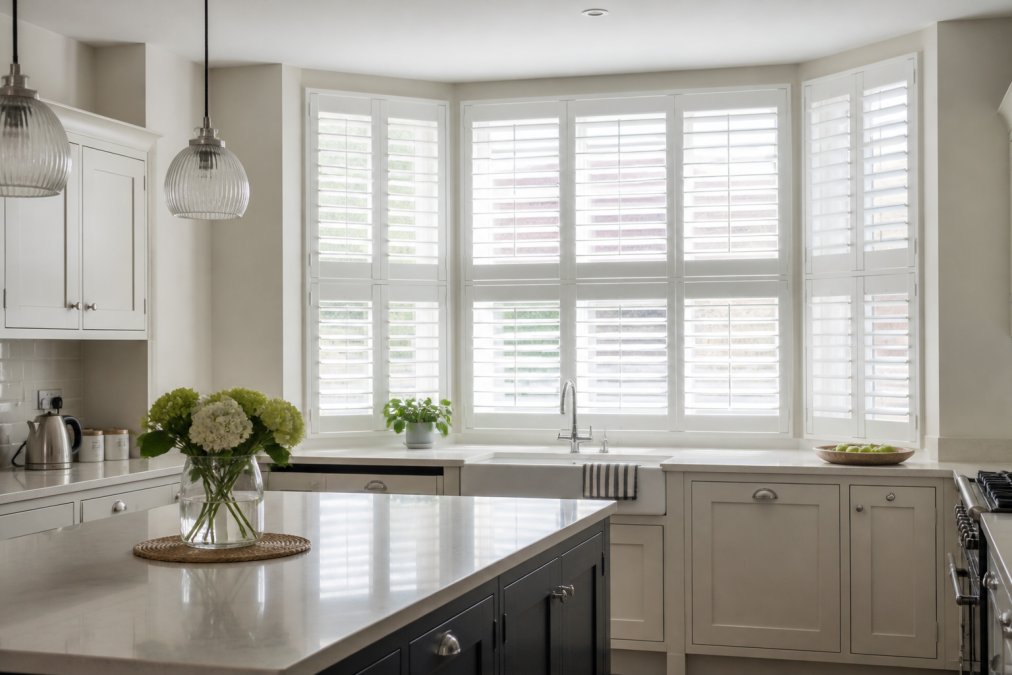
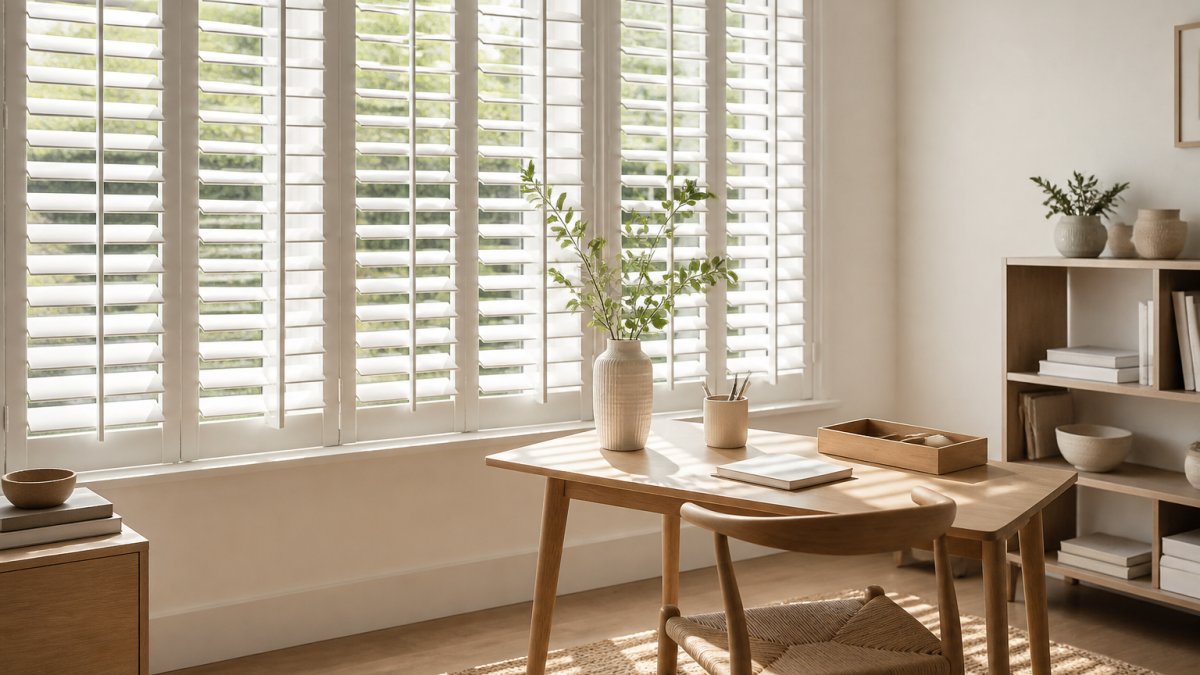
The biggest advantage of plantation shutters is directional light control. Tilting the louvres lets you bounce daylight off the ceiling or push it deep into a room while cutting the harsh glare that washes out pale interiors. Full closure gives near-blackout conditions where you need them.
For anyone weighing up how shutters handle light compared with fabric, our guide to plantation shutters versus blinds breaks down the practical differences. In a Scandi scheme, that control matters more than it sounds: bleached oak and chalky whites look flat under flat, unfiltered light, but come alive when daylight is diffused through angled louvres. You get the airy feel without the washout.
Clean Lines, Organic Textures and the Minimalist Aesthetic
Clean lines are the defining feature of Scandi window dressing, and shutters deliver them without fuss. A fitted frame sits flush to the reveal, louvres stay slim, and there is no bulky fabric to interrupt the architecture. That flat profile is what makes shutters read as part of the room rather than an addition to it.
The texture matters just as much. Timber louvres bring a subtle wood grain and organic warmth that softens an otherwise crisp, clutter-free space. Pair them with linen, wool and pale timber and the whole room feels calm rather than clinical. A common mistake is choosing a glossy finish; a matt or satin paint keeps the look honest and lets the natural material show through.
The Best Shutter Colours for Minimalist Homes
The best shutter colours for minimalist homes are soft whites, chalky off-whites and pale greys, with warm timber tones for rooms that need depth. Pure brilliant white can look stark against a Nordic palette, so a slightly muted white usually blends better with limewash walls and natural fabrics.
A practical starting point is to match the shutter to the lightest tone in the room rather than the darkest. That keeps the window wall receding and the space feeling open. In practice, most Scandi schemes fall into three families:
Finish matters as much as shade, and the choice of matt, satin or gloss affects how light sits in the room.
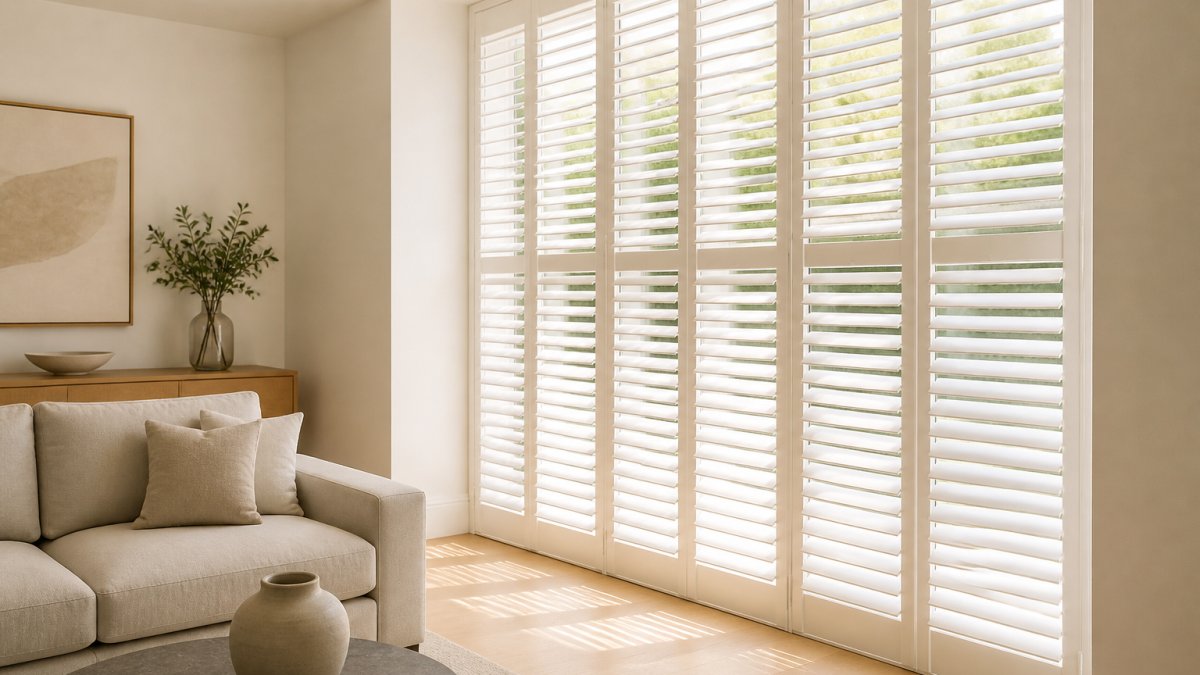
A useful rule of thumb is to match the shutters to the lightest tone in the room, not the darkest. That keeps the window wall receding and the space feeling open.
Watch out: sampling a colour chip against a wall in artificial light is the most common way to get this wrong. Ask for a physical sample and hold it against the window reveal at different times of day, because an off-white that looks warm under a bulb can turn grey in north light.
Full Height or Tier-on-Tier: Choosing the Right Style
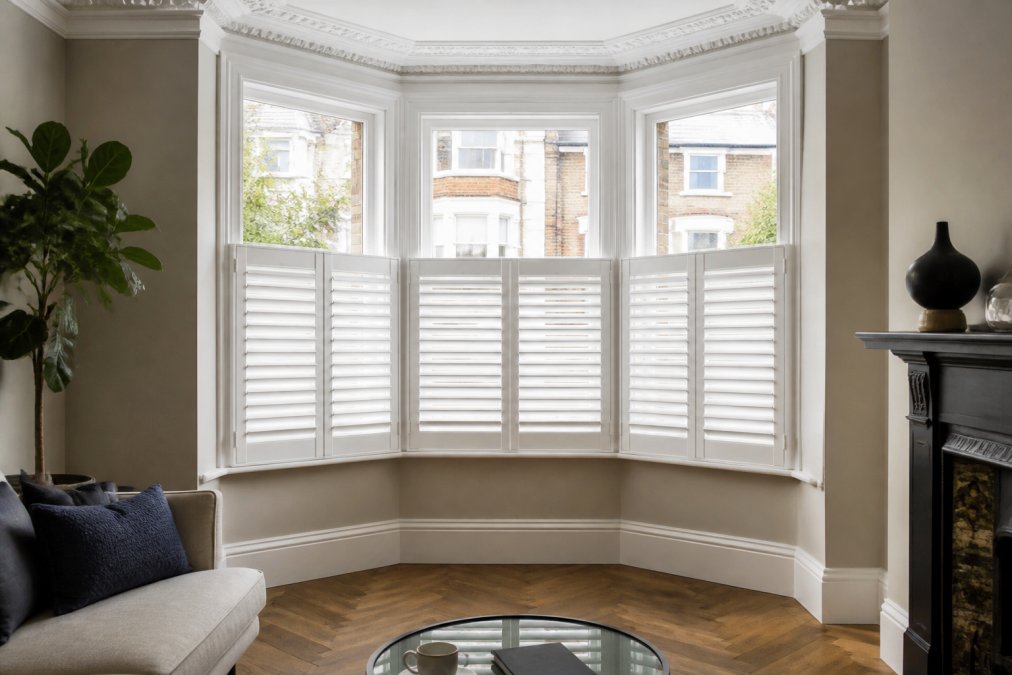
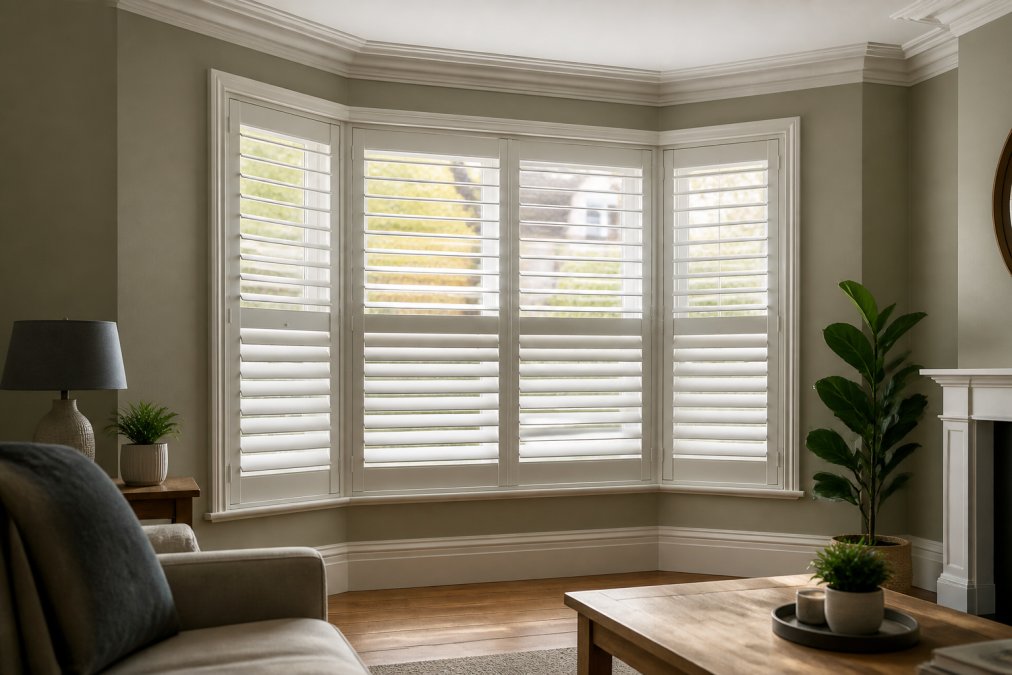
Full height shutters cover the whole window with one continuous panel, giving the cleanest possible line. Tier-on-tier splits the window into independent top and bottom sections, so you can open the lower half for privacy while keeping daylight coming through the top.
For most Scandi-inspired rooms, full height wins on looks. Tier-on-tier wins on practicality, especially in bay windows or rooms that face the street. If you are working with a bay, our bespoke shutters for bay windows fitting guide explains which configurations actually suit the frame rather than fighting it.
| Style | Best for | Trade-off |
|---|---|---|
| Full height | Clean lines, tall windows | Less flexibility on privacy |
| Tier-on-tier | Street-facing rooms, bays | Slight break in the vertical line |
| Café style | Ground-floor privacy | Less light control at the top |
Bespoke Shutter Installation for Period Properties
Period properties rarely offer square, plumb windows, which is why bespoke fitting matters. Victorian terraces, sash windows and arched frames all need panels made to the actual opening, not adapted from a standard size. Off-the-shelf shutters in an old bay tend to stick, rattle or leave gaps.
Every set is made from scratch, so bay, arched and awkward shapes can be handled to measure. Owners of older homes will find more detail in our guide to plantation shutters for Victorian bay windows.
Acoustics, Energy Efficiency and Smart Home Integration
Shutters help with more than looks, but each of these benefits works in a specific way and has limits worth knowing before you buy.
Acoustics. A closed shutter adds a layer at the window that can take the edge off street noise, which matters in busy urban rooms. The effect comes from the sealed air gap between the louvres and the glass plus the mass of the panel itself, so a full-height shutter with tight-fitting louvres performs better than a café-style panel that leaves the top of the window open. The gain is generally modest: enough to soften traffic hum, but not a substitute for secondary glazing where noise is severe. Scandi interiors lean on hard surfaces, so this is often the one place a shutter earns its keep beyond aesthetics.
Energy efficiency. A fitted shutter creates a buffer of still air between the glass and the room, which slows heat loss at the window. The gain depends on fit: a frame that sits flush to the reveal and closes tightly traps more still air than a loose panel with gaps. Our comparison of energy-efficient blinds versus shutters looks at how the two perform. Watch out: shutters are not a substitute for glazing upgrades, so treat any thermal gain as a bonus rather than the reason to buy, and do not expect a closed shutter to outperform a properly draught-proofed window.
Smart home integration. Motorised louvres can be set to open at sunrise and close at dusk, which suits the Nordic rhythm of maximising daylight. The practical version of this is a schedule that tracks sunrise and sunset through the year, so the room is brightest when you need it and private when you do not, without anyone touching a tilt rod. It is a small upgrade that keeps the minimal look intact, and it pairs naturally with smart lighting that dims as daylight fades. The trade-off is that motorised systems need power at the window and add cost and a serviceable component to an otherwise mechanical product, so specify it where the window is hard to reach or the schedule genuinely saves effort.
Sustainability. Scandi design is rooted in eco-consciousness, and this is where shutters have a genuine story that most guides ignore. Ask any supplier for the chain-of-custody certification on the timber and the VOC content of the finish before you commit.
Book a Free Home Consultation and Measurement
Choosing shutters for a Scandi interior comes down to three things: light control, clean lines and a colour that lets the room breathe. Get those right and the window stops being a compromise and starts being part of the design.
At Shutters West London, we bring 30 years of family-run craftsmanship to every job, with 100% made-to-measure shutters and a free home consultation and measurement. We handle bay, arched and awkward windows and offer personalisation of styles, colours and tilt rods. Our 10/10 Checkatrade rating is based on customer reviews.
Get started with Shutters West London and book your free home consultation today.
Frequently Asked Questions
Do plantation shutters suit minimalist interior design?
Yes. Plantation shutters are built around the same principles as minimalist interiors: clean lines, a clutter-free surface and functional design. The louvres sit flush within a simple frame, so there is no fabric, valance or trailing cord to break up the window. In a Scandi scheme, that restraint mattrs more than ornament. A made-to-measure set also removes the need for curtains or blinds, which keeps sightlines across a room unbroken and reinforces the airy feel the style depends on.
What colour shutters work best for a Scandi-style home?
A neutral palette does most of the work. Soft white, chalk, warm off-white and pale greys keep the window dressing quiet and let natural light bounce around the room. If you want a little more depth, a light oak or ash finish with a visible wood grain adds organic texture without shouting. Avoid strong contrasts and high-gloss finishes, which fight the calm, matt look Scandi interiors rely on. Order a sample and check it against your wall colour in daylight before committing.
How do plantation shutters improve light control in Scandi homes?
The tilt rod lets you angle the louvres in small increments, so you can direct light rather than simply block it. Tilt them up and daylight is diffused across the ceiling; tilt them down and you get a softer wash across the floor. That level of adjustment is hard to achieve with curtains, which tend to be open or closed. For bedrooms, an optional blackout feature can be added to the same frame, so you keep the clean look without buying a separate blind.
Can bespoke shutters be fitted to bay and arched windows in older properties?
They can, but it needs proper measuring rather than a template. Bay windows in period homes are rarely square, and arched or shaped frames require each panel to be made from scratch to follow the curve. That is why a home consultation and measurement mattrs: the fitter records the actual angles, depths and recesses on site. Shutters West London has handled bay, arched and awkward window shapes for three decades, and every set is made to measure rather than adapted from a standard size.
A well-fitted set of shutters should disappear into the architecture while quietly doing the hard work of light and privacy. That is the Scandi ideal, and it is achievable in almost any home with the right measurements and the right material. If you want the fit to be right the first time, our team is ready to measure up and talk through the options with no obligation.